

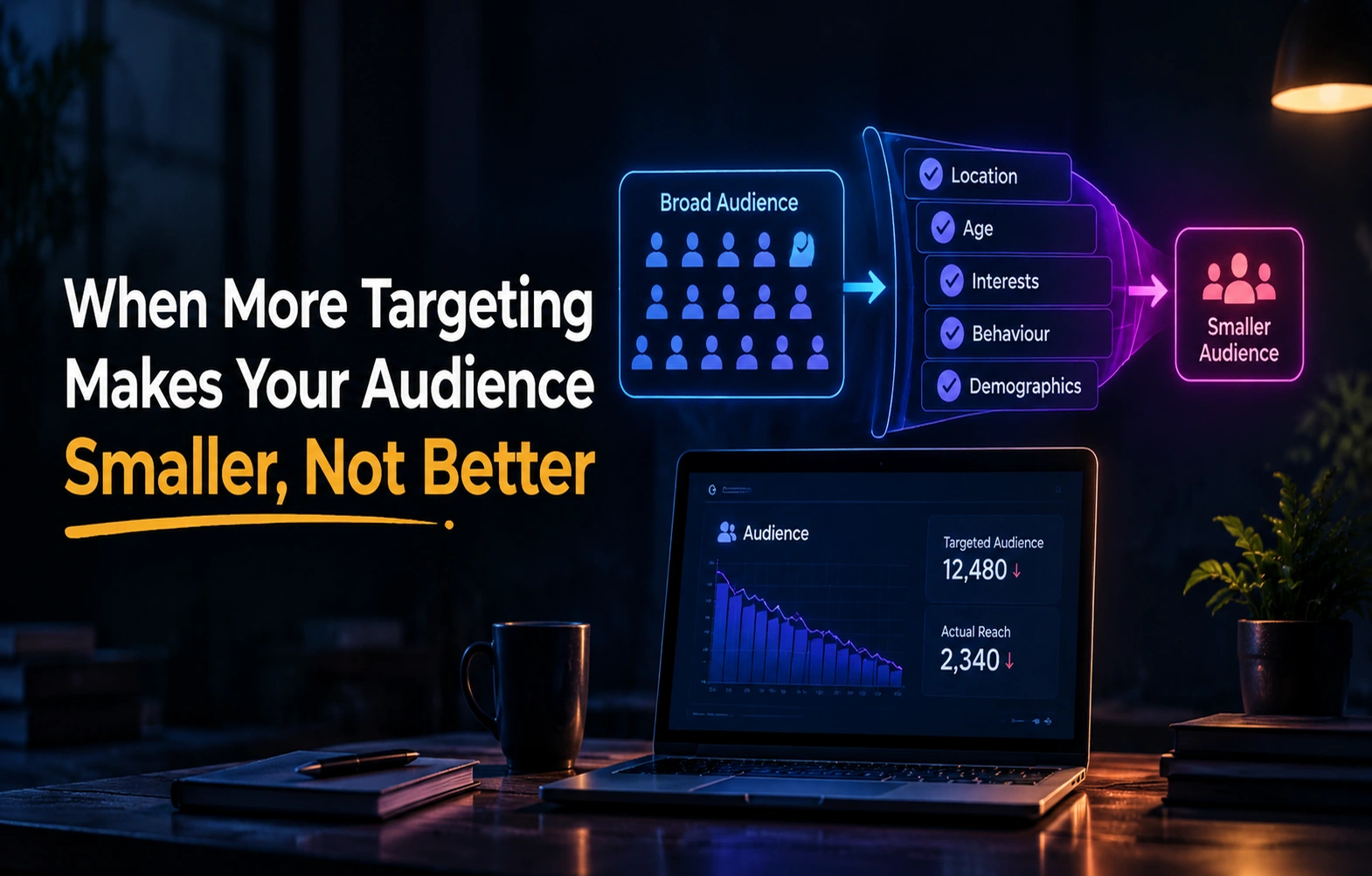
The more specific your audience, the better your ads perform. That’s what most marketers assume, anyway.
So, you start broad and narrow it down by age, location, interests, behaviour, and buying habits, until you’re sure your ads cater to the right set of people. Why pay to show an ad to someone who probably won’t care?
Here’s the catch. In trying to reach the right people, you can end up shutting out the ones who would have bought from you.
That’s how audience targeting backfires. A sensible effort to improve relevance slowly narrows your audience, cuts your reach, and caps your growth.
Brands do the same thing when they hold on too tightly to a niche. A clearly defined audience is valuable. But if you decide that only one very specific group could care about what you sell, you stop reaching anyone outside it.
So, does more precise targeting mean better advertising? Not always.
The Problem with Trying to Find the Perfect Audience
Say you run a skincare brand. marketing segmentation Your products are made for people in their late twenties with dry skin, a set skincare routine, and an interest in minimal beauty.
That’s a reasonable place to start with digital advertising targeting.
Now think about someone in their early forties with the same dry skin. Or someone who has only just started getting into skincare. Or a person who doesn’t follow a single beauty brand online but is actively searching for something that fixes dry skin.
They could be just as likely to buy. If your targeting is too restrictive, your ads never reach them.
That’s the trouble with overly limited audience segmentation. It pushes marketers to lean on what they already know about their customers and leaves no room to find out who else is interested.
You don’t need to stop defining your audience. You just need to accept that what you know about them might not be the full story.
When Maintaining a Niche Becomes a Limitation
Every brand need direction. A niche helps you explain your value, stand apart from competitors, and connect with people who are likely to care.
It becomes a problem when the niche hardens into a rule about who’s allowed to be your customer.
Take a brand that sells premium, minimalist furniture. It might assume its buyers are affluent homeowners between 35 and 50 who follow interior design accounts. That sounds logical for targeted advertising. But it skips the young professionals furnishing their first apartment, the people renovating an inherited home, and anyone who likes minimalist design without following a single design page.
The product hasn’t changed. Those buyers haven’t vanished. The brand just drew the line too tightly around who it was for.
A niche should guide your marketing, not put your brand in a box.
Customer interests rarely sort into neat categories. People find products through all sorts of channels, pick up new tastes, and buy for reasons that don’t match their demographic profile. Good marketing segmentation helps you see those differences. It shouldn’t turn them into grounds for excluding people when you have no evidence to back it up.
Why More Precise Targeting Can Work Against You
Narrowing your audience too far can hurt performance in a few ways.
1. You reduce your chances of finding new customers
If your audience only includes people who look like your current customers, your campaigns will struggle to reach anyone with a different background, interest, or buying habit. Some of them would be interested in your product even though their profiles don’t fit your assumptions.
Overly restrictive audience targeting keeps you from ever finding them.
2. Your assumptions start doing the targeting
Marketers build segments from customer data, past campaign results, and observed behaviour. Those are useful inputs, but they don’t predict future demand on their own. If your customers so far have mostly been women aged 25 to 35, that doesn’t mean other age groups or genders won’t respond to your ads. Treat past patterns as fixed rules, and your targeting gets stiff.
Try asking “Who else might benefit from what we offer?” instead of only “Who has bought from us before?”
It’s a small shift, and it opens a lot.
3. Your campaigns have less room to learn
Ad platforms use campaign data to find people who are more likely to take the action you want. Pile on too many restrictions and you shrink the pool of people and interactions that data can come from, which weakens optimisation.
How much it matters depends on the platform, the campaign objective, your budget and your conversion data. A small audience isn’t automatically a problem. An unnecessarily small one can make it harder to find more of the right people.
Precision helps when it keeps a campaign focused. When it stops the campaign from learning, it’s costing you.
4. You confuse relevance with exclusivity
An ad isn’t more relevant just because fewer people can see it.
A well-targeted campaign matches a message with people who have a real reason to care. Sometimes that’s a very specific group. Other times it means giving a wider audience the chance to find something they didn’t know they needed.
Good digital advertising targeting isn’t measured by how tightly you’ve drawn the audience. What counts is whether your message connects with the people who see it.
How to Find the Right Balance Between Precision and Reach
You don’t need to drop targeted advertising and show every ad to everyone. You need to base your targeting decisions on evidence, not assumptions. A few ways to do that:
1. Start with a clear audience, but leave room to expand
Define your core audience using what you know about your customers, their needs and how they buy. Then look at neighbouring groups who might share those needs, even if their demographics or interests differ.
Your core audience gives the campaign direction. The broader segments show you where else demand might be hiding.
2. Test broader audiences instead of guessing
If your campaigns currently target a narrow segment, run a broader audience next to it, as far as the platform and objective allow.
Keep the creative, budget, and measurement similar enough that the results actually mean something. Judge it on conversions, cost per acquisition, and revenue, not reach alone. That tells you whether your restrictions are improving performance or just cutting the number of people who see your ads.
3. Review your exclusions
Exclusions earn their place when they stop wasted spend, like keeping existing customers out of a campaign built to win new ones. But each one should have a clear reason. Check whether every restriction is really needed, especially the ones based on assumptions rather than campaign results.
Sometimes removing one shows you an opportunity that was there all along.
4. Let performance data challenge your assumptions
Effective marketing segmentation isn’t a one-off job. Customer behaviour shifts, markets change and new audiences appear.
Check your results regularly. Look for segments that do better than you expected, groups that respond to different creative messages, and openings your original targeting missed. Keep learning about your audience rather than squeezing every new insight into the definition you started with.
5. Better Targeting Is About Better Decisions, Not Smaller Numbers
A smaller audience can be valuable when it’s a genuinely specialised market or when the campaign has a specific goal. But smaller doesn’t mean better by default.
The same goes for a niche. Being known for something specific helps a brand stand out. Being so rigid about that identity that you overlook potential customers holds it back.
The best audience targeting balances relevance with room to discover something new. Customer insights guide the decisions, campaign data tests the assumptions, and experiments turn up opportunities beyond the obvious.
At Anvis Digital, the bigger question isn’t how precisely you can define your audience. It’s whether those definitions are helping your brand reach the people most likely to respond.
Because sometimes, the audience you’re looking for is bigger than the one you’ve defined.
FAQs
1. What is audience targeting in digital advertising?
Audience targeting means choosing the people who are most likely to be interested in an ad, based on things like demographics, interests, behaviour, location, or past interactions with a brand.
2. Is a smaller target audience always better?
No. A smaller audience can improve relevance when the criteria reflect real customer needs. But too many limitations can shut out potential customers and hide new segments. The right audience size depends on your campaign objective, budget, and available data.
3. What is the difference between audience targeting and audience segmentation?
Audience segmentation splits a broader market into groups that share characteristics, needs, or behaviours. Audience targeting is choosing which of those groups to reach with a campaign. Segmentation helps you understand your market, and targeting helps you decide where to focus.
4. How can marketers improve their targeting strategy?
Review campaign performance, test broader audiences, remove audience filters you don’t need, and use customer data to check your assumptions. Regular experiments help you spot opportunities beyond your existing customer profile.
5. How does overly narrow targeting affect campaign performance?
It can reduce reach, limit your chances of acquiring new customers, and shrink the data available for optimisation. The impact varies by platform and campaign objective, though, so judge it on actual performance rather than assuming a smaller audience will always do worse.