

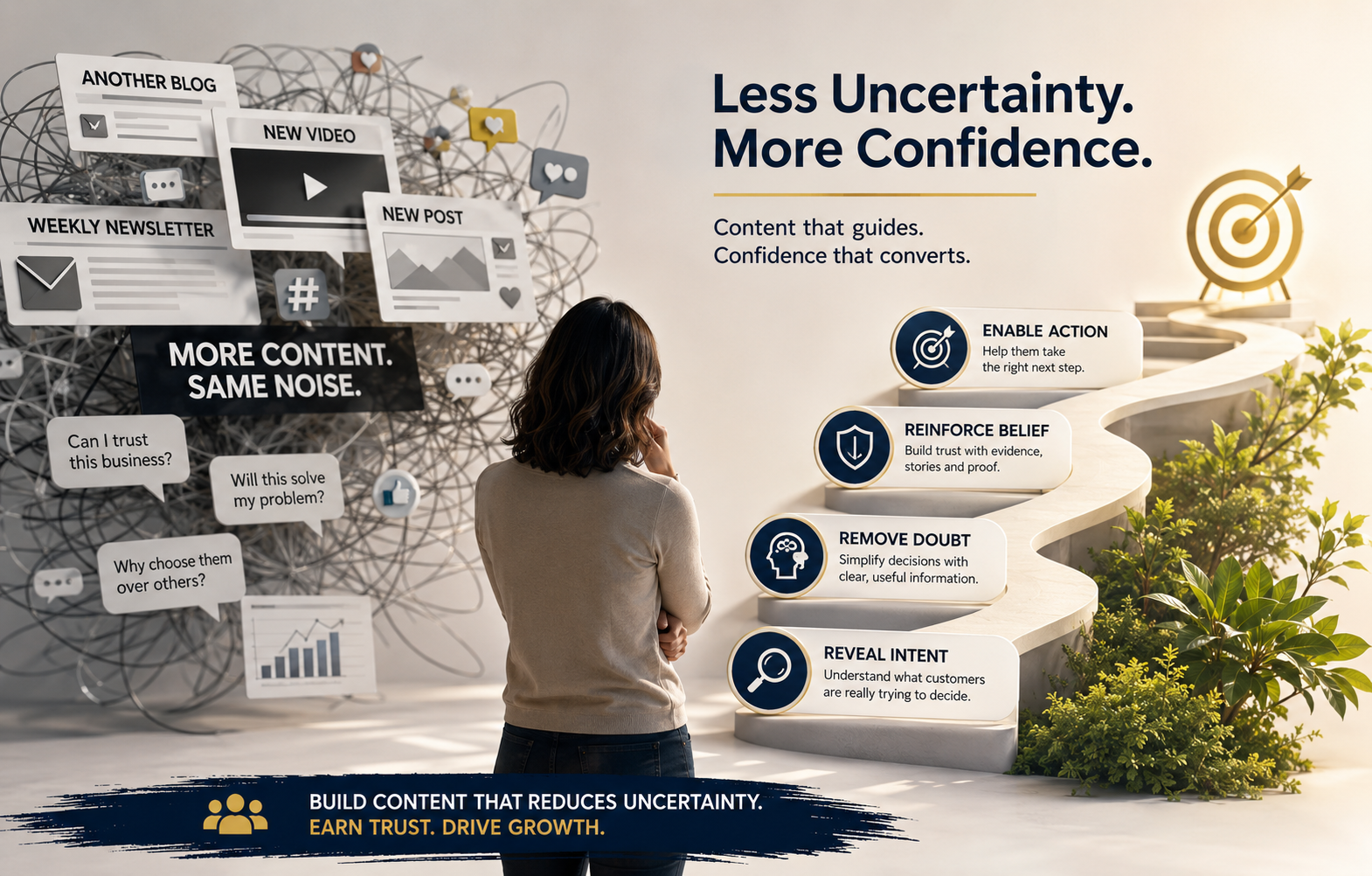
Every week, another blog gets published.
Another carousel goes live.
Another video is uploaded.
Another newsletter lands in an inbox.
Brands are producing more content than ever before.
Yet customers are not making decisions any faster.
The problem is not a shortage of content.
It is a shortage of clarity.
Customers rarely wake up wishing brands would publish more. They want answers. They want confidence. They want proof. They want someone to help them make the right decision.
That is where a successful content marketing strategy begins.
Not with a publishing calendar.
With customer uncertainty.
Another carousel goes live.
Another video is uploaded.
Another newsletter lands in an inbox.
Brands are producing more content than ever before.
Yet customers are not making decisions any faster.
The problem is not a shortage of content.
It is a shortage of clarity.
Customers rarely wake up wishing brands would publish more. They want answers. They want confidence. They want proof. They want someone to help them make the right decision.
That is where a successful content marketing strategy begins.
Not with a publishing calendar.
With customer uncertainty.
The Hidden Reality
The hidden reality is this: content is not ignored because there is too much of it.
It is ignored because too much of it says the same thing.
Businesses often create content to satisfy algorithms instead of customers. Articles chase rankings. Social posts chase engagement. Videos chase trends.
Meanwhile, customers are still asking the same questions.
Can I trust this business?
Will this solve my problem?
Why should I choose them instead of someone else?
If your content does not answer those questions, publishing more simply creates more noise.
Content should never compete for attention alone.
It should compete for belief.
It is ignored because too much of it says the same thing.
Businesses often create content to satisfy algorithms instead of customers. Articles chase rankings. Social posts chase engagement. Videos chase trends.
Meanwhile, customers are still asking the same questions.
Can I trust this business?
Will this solve my problem?
Why should I choose them instead of someone else?
If your content does not answer those questions, publishing more simply creates more noise.
Content should never compete for attention alone.
It should compete for belief.
The Anvis Confidence Loop
At Anvis Digital, we believe every piece of content should move customers one step closer to confidence, not just one step deeper into your website.
That happens through four connected stages.
Reveal Intent – Go beyond search volume and understand what customers are actually trying to decide. Effective keyword research uncovers intent, hesitation and unanswered questions.
Remove Doubt – Replace vague marketing language with useful explanations that make complex decisions feel simpler.
Reinforce Belief – Demonstrate expertise through evidence, practical insights, customer stories and meaningful proof instead of making bigger claims.
Enable Action – Help customers recognise the right next step naturally, without forcing a sale before confidence exists.
When these four stages work together, your content strategy becomes a confidence-building system instead of a publishing system.
That happens through four connected stages.
Reveal Intent – Go beyond search volume and understand what customers are actually trying to decide. Effective keyword research uncovers intent, hesitation and unanswered questions.
Remove Doubt – Replace vague marketing language with useful explanations that make complex decisions feel simpler.
Reinforce Belief – Demonstrate expertise through evidence, practical insights, customer stories and meaningful proof instead of making bigger claims.
Enable Action – Help customers recognise the right next step naturally, without forcing a sale before confidence exists.
When these four stages work together, your content strategy becomes a confidence-building system instead of a publishing system.
Quality Compounds. Quantity Expires.
Many businesses measure success by how much they publish.
Customers measure success by how much they learn.
That is why quality content creates value long after it is published.
Strong content continues earning search visibility, attracts backlinks, gets shared in conversations, supports sales discussions, answers recurring customer questions and strengthens trust across multiple touchpoints.
High-volume content often creates activity.
High-quality content creates assets.
The purpose of content is not to prove how much your brand knows.
It is to remove enough uncertainty for customers to trust what your brand knows.
That difference is what makes great content compound over time.
Customers measure success by how much they learn.
That is why quality content creates value long after it is published.
Strong content continues earning search visibility, attracts backlinks, gets shared in conversations, supports sales discussions, answers recurring customer questions and strengthens trust across multiple touchpoints.
High-volume content often creates activity.
High-quality content creates assets.
The purpose of content is not to prove how much your brand knows.
It is to remove enough uncertainty for customers to trust what your brand knows.
That difference is what makes great content compound over time.
Content Should Never Work Alone
Great content is powerful.
Connected content is even more powerful.
The strongest brands do not treat blogs, SEO, landing pages, websites, email campaigns and social media as separate activities.
They treat them as one connected customer journey.
A blog answers an early question.
A landing page removes hesitation.
The website reinforces credibility.
Search brings intent.
Analytics reveal where confidence begins to disappear.
This is where content that converts is created.
Not because every article sells.
But because every piece strengthens the customer’s confidence before the sale.
This is also why digital marketing should never be viewed as disconnected channels.
Every touchpoint should reinforce the same promise.
Every interaction should make uncertainty smaller.
Connected content is even more powerful.
The strongest brands do not treat blogs, SEO, landing pages, websites, email campaigns and social media as separate activities.
They treat them as one connected customer journey.
A blog answers an early question.
A landing page removes hesitation.
The website reinforces credibility.
Search brings intent.
Analytics reveal where confidence begins to disappear.
This is where content that converts is created.
Not because every article sells.
But because every piece strengthens the customer’s confidence before the sale.
This is also why digital marketing should never be viewed as disconnected channels.
Every touchpoint should reinforce the same promise.
Every interaction should make uncertainty smaller.
Build Content That Reduces Uncertainty
Customers do not need more information.
They need better guidance.
They do not need another article explaining why your company is different.
They need evidence that helps them believe it.
At Anvis Digital, content is built to reduce uncertainty before it tries to generate enquiries.
Because trust is earned before conversions happen.
The brands that win are not the ones publishing the most.
They are the ones reducing the most uncertainty.
Your customer does not need more content.
They need content that leaves fewer questions unanswered than your competitor’s.
They need better guidance.
They do not need another article explaining why your company is different.
They need evidence that helps them believe it.
At Anvis Digital, content is built to reduce uncertainty before it tries to generate enquiries.
Because trust is earned before conversions happen.
The brands that win are not the ones publishing the most.
They are the ones reducing the most uncertainty.
Your customer does not need more content.
They need content that leaves fewer questions unanswered than your competitor’s.
FAQs
1. Why is publishing more content not always effective?
Publishing more content only increases visibility if it provides value. Customers are more likely to engage with quality content that answers questions, builds trust and helps them make confident decisions.
2. How does keyword research improve content strategy?
Keyword research reveals what customers are searching for and, more importantly, why they are searching. This helps businesses create content that aligns with customer intent rather than simply targeting search volume.
3. What is content that converts?
Content that converts reduces customer hesitation by answering important questions, demonstrating expertise and naturally guiding readers toward the next step in their buying journey.
4. How does Anvis Digital approach content marketing?
Anvis Digital helps businesses reduce customer uncertainty by connecting strategy, search intent, messaging, content, websites and customer journeys into one integrated system that builds trust before asking customers to make a decision.