

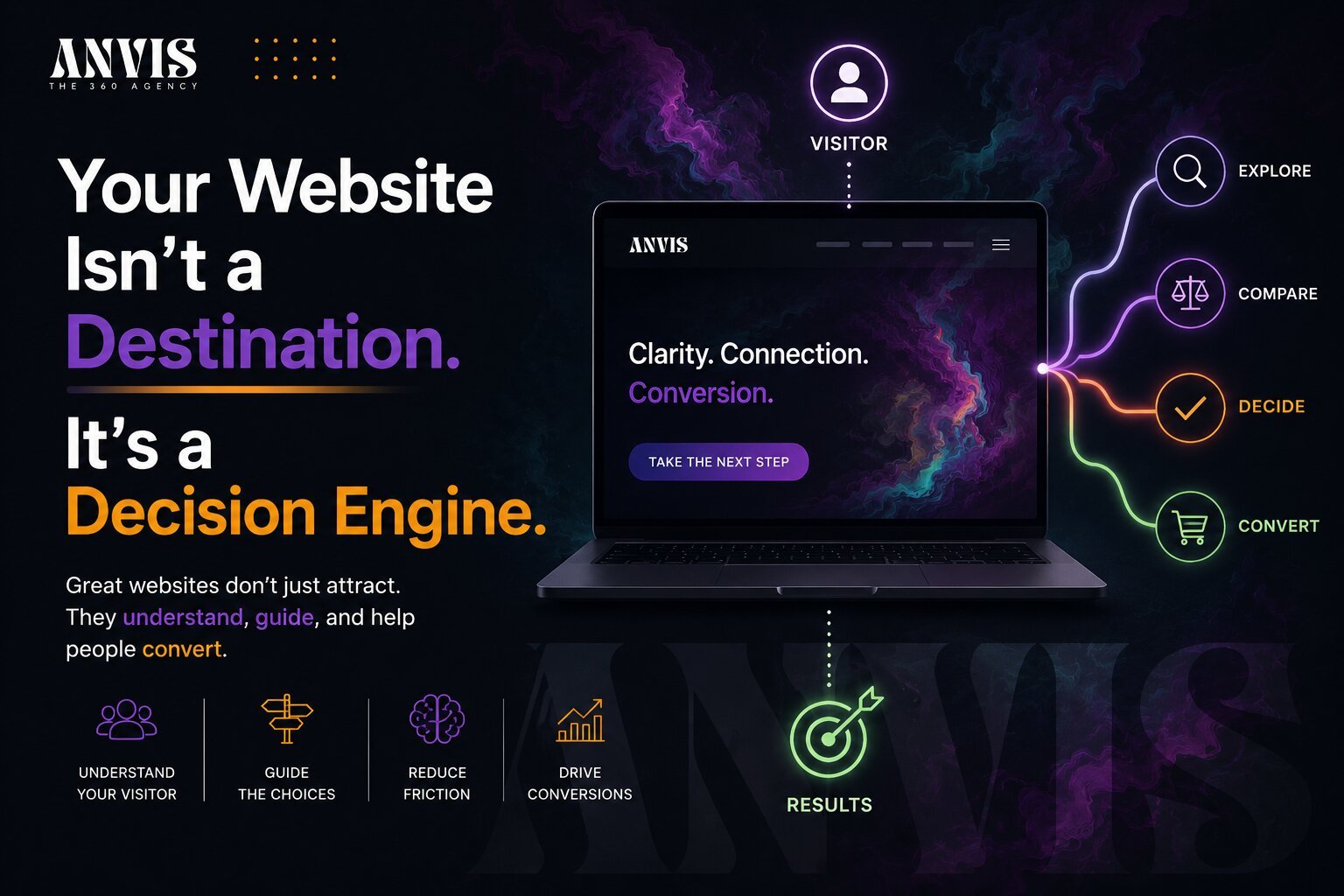
Many businesses treat their website as the finish line.
A place customers visit after seeing an advertisement, clicking a search result, or discovering the brand on social media.
That thinking is expensive.
Your website is not where the customer journey ends.
It is where decisions are made.
Every visitor arrives with a question, a hesitation or an expectation. Some want proof. Some want clarity. Others simply want to know whether your business understands their problem better than anyone else.
The role of a website is not to impress.
It is to help customers move forward.
That is why website conversion optimisation should never begin with buttons, colours or layouts. It should begin with understanding the decision your customer is trying to make.
A place customers visit after seeing an advertisement, clicking a search result, or discovering the brand on social media.
That thinking is expensive.
Your website is not where the customer journey ends.
It is where decisions are made.
Every visitor arrives with a question, a hesitation or an expectation. Some want proof. Some want clarity. Others simply want to know whether your business understands their problem better than anyone else.
The role of a website is not to impress.
It is to help customers move forward.
That is why website conversion optimisation should never begin with buttons, colours or layouts. It should begin with understanding the decision your customer is trying to make.
The Hidden Reality
The hidden reality is this: most websites do not lose customers because they look outdated.
They lose customers because they make decisions harder.
Customers arrive with intent but leave with unanswered questions. They cannot immediately understand the offer. They struggle to find proof. They encounter unnecessary friction. They keep searching because uncertainty still exists.
The website did not fail because it lacked traffic.
It failed because it failed to reduce doubt.
Traffic is only the arrival.
Confidence drives conversion.
They lose customers because they make decisions harder.
Customers arrive with intent but leave with unanswered questions. They cannot immediately understand the offer. They struggle to find proof. They encounter unnecessary friction. They keep searching because uncertainty still exists.
The website did not fail because it lacked traffic.
It failed because it failed to reduce doubt.
Traffic is only the arrival.
Confidence drives conversion.
The Anvis Decision Engine
At Anvis Digital, every high-performing website is built around four connected decision drivers that move customers from curiosity to confidence.
Instant Clarity answers the customer’s first question: *Am I in the right place?* Visitors should immediately understand who you help, what you solve and why it matters.
Trust Signals answer the second question: Can I believe you? Reviews, case studies, certifications, expertise and transparent messaging reduce perceived risk before the customer starts comparing alternatives.
Decision Flow answers the third question: What should I do next? Every page, section, headline and call-to-action should make the next step feel obvious instead of overwhelming.
Confidence Reinforcement answers the final question: Have I made the right choice? Every touchpoint should reinforce the same promise, so customers feel increasingly certain rather than increasingly confused.
This is where website user experience becomes far more than a design discipline.
It becomes a decision-making system.
Instant Clarity answers the customer’s first question: *Am I in the right place?* Visitors should immediately understand who you help, what you solve and why it matters.
Trust Signals answer the second question: Can I believe you? Reviews, case studies, certifications, expertise and transparent messaging reduce perceived risk before the customer starts comparing alternatives.
Decision Flow answers the third question: What should I do next? Every page, section, headline and call-to-action should make the next step feel obvious instead of overwhelming.
Confidence Reinforcement answers the final question: Have I made the right choice? Every touchpoint should reinforce the same promise, so customers feel increasingly certain rather than increasingly confused.
This is where website user experience becomes far more than a design discipline.
It becomes a decision-making system.
User Experience Is Decision Psychology
Many businesses think user experience is about making websites easier to use.
That is only part of the story.
People rarely abandon a website because they cannot click a button.
They leave because they cannot justify a decision.
A vague headline creates uncertainty.
Weak proof creates doubt.
Confusing navigation creates hesitation.
Generic messaging creates comparison.
Every unnecessary question the customer must answer alone increases the likelihood of leaving.
Good design attracts attention.
Good decision paths create conversions.
That is why website optimisation is not about making websites prettier.
It is about removing uncertainty until saying “yes” feels easier than continuing the search.
That is only part of the story.
People rarely abandon a website because they cannot click a button.
They leave because they cannot justify a decision.
A vague headline creates uncertainty.
Weak proof creates doubt.
Confusing navigation creates hesitation.
Generic messaging creates comparison.
Every unnecessary question the customer must answer alone increases the likelihood of leaving.
Good design attracts attention.
Good decision paths create conversions.
That is why website optimisation is not about making websites prettier.
It is about removing uncertainty until saying “yes” feels easier than continuing the search.
A Website Should Never Work Alone
The highest-converting websites succeed because they are connected to a broader digital strategy.
Search brings intent.
Content builds understanding.
Landing pages answer objections.
Media brings qualified audiences.
Analytics reveal where customers stop believing.
Together, these touchpoints remove friction before customers are forced to decide.
This is also why SEO should never be treated as a ranking exercise alone.
Ranking is only valuable when visitors arrive on pages that answer questions, reinforce credibility and guide them confidently toward the next step.
Otherwise, better rankings simply send more people into the same conversion problems.
Search brings intent.
Content builds understanding.
Landing pages answer objections.
Media brings qualified audiences.
Analytics reveal where customers stop believing.
Together, these touchpoints remove friction before customers are forced to decide.
This is also why SEO should never be treated as a ranking exercise alone.
Ranking is only valuable when visitors arrive on pages that answer questions, reinforce credibility and guide them confidently toward the next step.
Otherwise, better rankings simply send more people into the same conversion problems.
Build Websites That Help Customers Decide
The strongest websites do not ask customers to work harder.
They work harder for the customer.
They remove confusion before it grows.
They answer questions before they are asked.
They reinforce trust before doubt appears.
They make every next step feel easier.
At Anvis Digital, websites are built as connected decision engines where strategy, messaging, content, search and user journeys work together to reduce uncertainty instead of simply increasing traffic.
Because the purpose of a website is not to tell customers everything about your business.
It is to remove enough uncertainty for them to confidently choose it.
They work harder for the customer.
They remove confusion before it grows.
They answer questions before they are asked.
They reinforce trust before doubt appears.
They make every next step feel easier.
At Anvis Digital, websites are built as connected decision engines where strategy, messaging, content, search and user journeys work together to reduce uncertainty instead of simply increasing traffic.
Because the purpose of a website is not to tell customers everything about your business.
It is to remove enough uncertainty for them to confidently choose it.
FAQs
1. Why is website conversion optimisation important?
Website conversion optimisation helps businesses turn more visitors into enquiries or customers by reducing friction, improving clarity and guiding users toward confident decisions.
2. How does website user experience affect conversions?
A strong website user experience makes information easier to understand, builds trust, reduces hesitation and helps customers make faster, more confident decisions.
3. Why should SEO and website optimisation work together?
SEO attracts relevant visitors, while website optimisation ensures those visitors find clear messaging, valuable information and intuitive journeys that encourage action instead of exit.
4. How does Anvis Digital approach website strategy?
Anvis Digital builds websites as connected decision engines by aligning strategy, messaging, search intent, content, user journeys and conversion goals so every interaction reduces uncertainty and makes customer decisions easier.