

Most brands misunderstand SEO because they treat it like a technical battle with Google.
They chase rankings, keywords, backlinks, metadata, page speed and algorithm updates. All that matters, but none of it is the real starting point.
The real starting point is people.
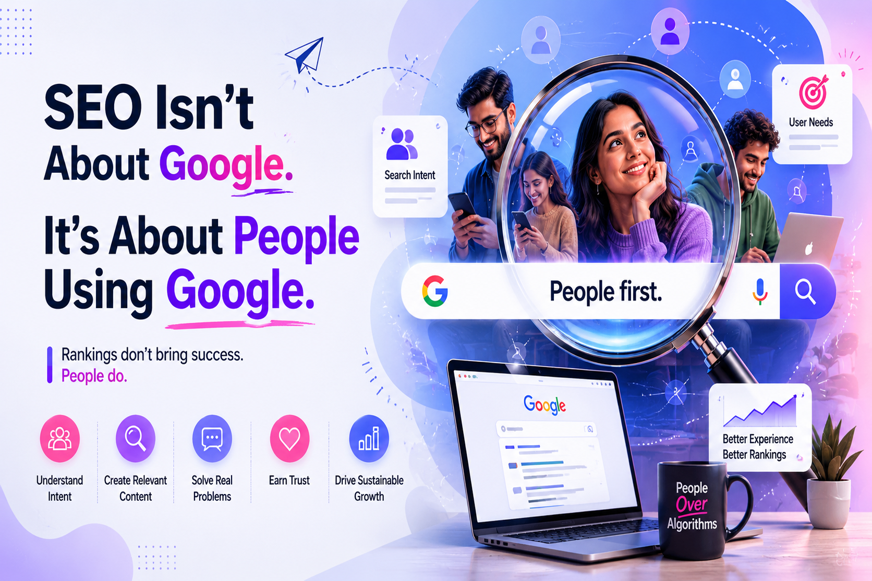
Google is not the audience. Google is the bridge. Behind every search query is a person with a question, fear, comparison, doubt, need or decision waiting to happen. A strong seo strategy is not about pleasing a machine first. It is about understanding why people search, what they expect to find and what will make them trust a brand once they arrive.
That is where SEO stops being a checklist and becomes a growth system.
They chase rankings, keywords, backlinks, metadata, page speed and algorithm updates. All that matters, but none of it is the real starting point.
The real starting point is people.
Google is not the audience. Google is the bridge. Behind every search query is a person with a question, fear, comparison, doubt, need or decision waiting to happen. A strong seo strategy is not about pleasing a machine first. It is about understanding why people search, what they expect to find and what will make them trust a brand once they arrive.
That is where SEO stops being a checklist and becomes a growth system.
Search is Human Behaviour in Disguise
Every search query is a tiny confession.
Someone searching “best school near me” is not just looking for a list. They may be worried about their child’s future. Someone searching “how to reduce hair fall” may be anxious about confidence, health or appearance. Someone searching “digital marketing agency in Mumbai” may be frustrated with scattered marketing and looking for clarity.
This is why SEO cannot be built only around keywords. Keywords are useful signals, but intent is the real treasure.
A keyword tells you what someone typed.
Intent tells you why they typed it.
That difference changes everything.
When brands understand intent, they create content that answers the user’s real question. When they do not, they produce pages that may rank but fail to persuade, convert or build trust.
Someone searching “best school near me” is not just looking for a list. They may be worried about their child’s future. Someone searching “how to reduce hair fall” may be anxious about confidence, health or appearance. Someone searching “digital marketing agency in Mumbai” may be frustrated with scattered marketing and looking for clarity.
This is why SEO cannot be built only around keywords. Keywords are useful signals, but intent is the real treasure.
A keyword tells you what someone typed.
Intent tells you why they typed it.
That difference changes everything.
When brands understand intent, they create content that answers the user’s real question. When they do not, they produce pages that may rank but fail to persuade, convert or build trust.
SEO Content Should Not Sound Written for Search Engines
A common mistake brands make is creating content that feels built for algorithms, not readers.
The headline includes the keyword. The introduction repeats it. The subheadings repeat variations of it. The article says technically correct things, but there is no point of view, no brand intelligence, no emotional understanding and no useful decision support.
That kind of content may exist on the internet, but it does not earn memory.
A strong SEO content strategy should balance discoverability with usefulness. It should help people find the brand, yes. But once they arrive, it should help them understand something better, make decisions faster or trust the brand more deeply.
Good SEO content should answer:
What is the user confused about?
What are they comparing?
What objection is stopping them?
What should they remember about this brand?
This is where SEO becomes more than traffic. It becomes guided persuasion.
The headline includes the keyword. The introduction repeats it. The subheadings repeat variations of it. The article says technically correct things, but there is no point of view, no brand intelligence, no emotional understanding and no useful decision support.
That kind of content may exist on the internet, but it does not earn memory.
A strong SEO content strategy should balance discoverability with usefulness. It should help people find the brand, yes. But once they arrive, it should help them understand something better, make decisions faster or trust the brand more deeply.
Good SEO content should answer:
What is the user confused about?
What are they comparing?
What objection is stopping them?
What should they remember about this brand?
This is where SEO becomes more than traffic. It becomes guided persuasion.
Rankings are Not the Final Goal
Ranking on Google is valuable, but ranking alone is not the win.
If a page gets traffic but no engagement, no enquiries, no recall and no conversion movement, the SEO is incomplete. Visibility without relevance is just expensive attention in slow motion.
A smarter SEO approach looks at the full journey.
First, the user searches. Then the page must attract the click. The content must hold attention. The brand must build trust. The website must guide action. The business must measure what happened next.
This is why SEO cannot sit separately from the larger digital marketing strategy. It must connect with website experience, brand messaging, content planning, performance campaigns, social proof, landing pages and conversion goals.
SEO brings people in.
Strategy decides what happens after they arrive.
Without that connection, brands may increase traffic and still wonder why growth feels stuck.
If a page gets traffic but no engagement, no enquiries, no recall and no conversion movement, the SEO is incomplete. Visibility without relevance is just expensive attention in slow motion.
A smarter SEO approach looks at the full journey.
First, the user searches. Then the page must attract the click. The content must hold attention. The brand must build trust. The website must guide action. The business must measure what happened next.
This is why SEO cannot sit separately from the larger digital marketing strategy. It must connect with website experience, brand messaging, content planning, performance campaigns, social proof, landing pages and conversion goals.
SEO brings people in.
Strategy decides what happens after they arrive.
Without that connection, brands may increase traffic and still wonder why growth feels stuck.
What Better SEO Looks Like
Better SEO begins before writing.
It starts with understanding the audience, mapping search intent, identifying decision stages, studying competitors, building content clusters, improving website journeys and defining what the brand should be remembered for.
For example, a brand should know the difference between informational, comparative, commercial and conversion-led searches. A blog may educate. A service page may persuade. A case study may build proof. A landing page may convert. A FAQ may remove doubt.
When all these pieces are connected, SEO becomes a long-term growth asset instead of a monthly content treadmill.
For Anvis Digital, SEO is not treated as a standalone technical service. It is part of a connected digital growth ecosystem. That means SEO must work with brand storytelling, website structure, content strategy, user experience, media intelligence and measurable business outcomes.
The goal is not only to rank. The goal is to help the right audience find the brand, understand its value, trust its expertise and move closer to action.
Because Google may decide what appears on the results page.
But people decide what matters.
It starts with understanding the audience, mapping search intent, identifying decision stages, studying competitors, building content clusters, improving website journeys and defining what the brand should be remembered for.
For example, a brand should know the difference between informational, comparative, commercial and conversion-led searches. A blog may educate. A service page may persuade. A case study may build proof. A landing page may convert. A FAQ may remove doubt.
When all these pieces are connected, SEO becomes a long-term growth asset instead of a monthly content treadmill.
For Anvis Digital, SEO is not treated as a standalone technical service. It is part of a connected digital growth ecosystem. That means SEO must work with brand storytelling, website structure, content strategy, user experience, media intelligence and measurable business outcomes.
The goal is not only to rank. The goal is to help the right audience find the brand, understand its value, trust its expertise and move closer to action.
Because Google may decide what appears on the results page.
But people decide what matters.
Conclusion
SEO is not about writing for Google. It is about writing for people who are using Google to solve something.
The brands that understand this build stronger visibility, stronger trust and stronger conversion journeys. They do not chase keywords blindly. They build answers, authority, relevance and recall.
A good SEO strategy brings traffic. A better strategy brings the right people to the right message at the right moment, with the right intent.
That is when SEO becomes more than ranking.
It becomes growth.
The brands that understand this build stronger visibility, stronger trust and stronger conversion journeys. They do not chase keywords blindly. They build answers, authority, relevance and recall.
A good SEO strategy brings traffic. A better strategy brings the right people to the right message at the right moment, with the right intent.
That is when SEO becomes more than ranking.
It becomes growth.