

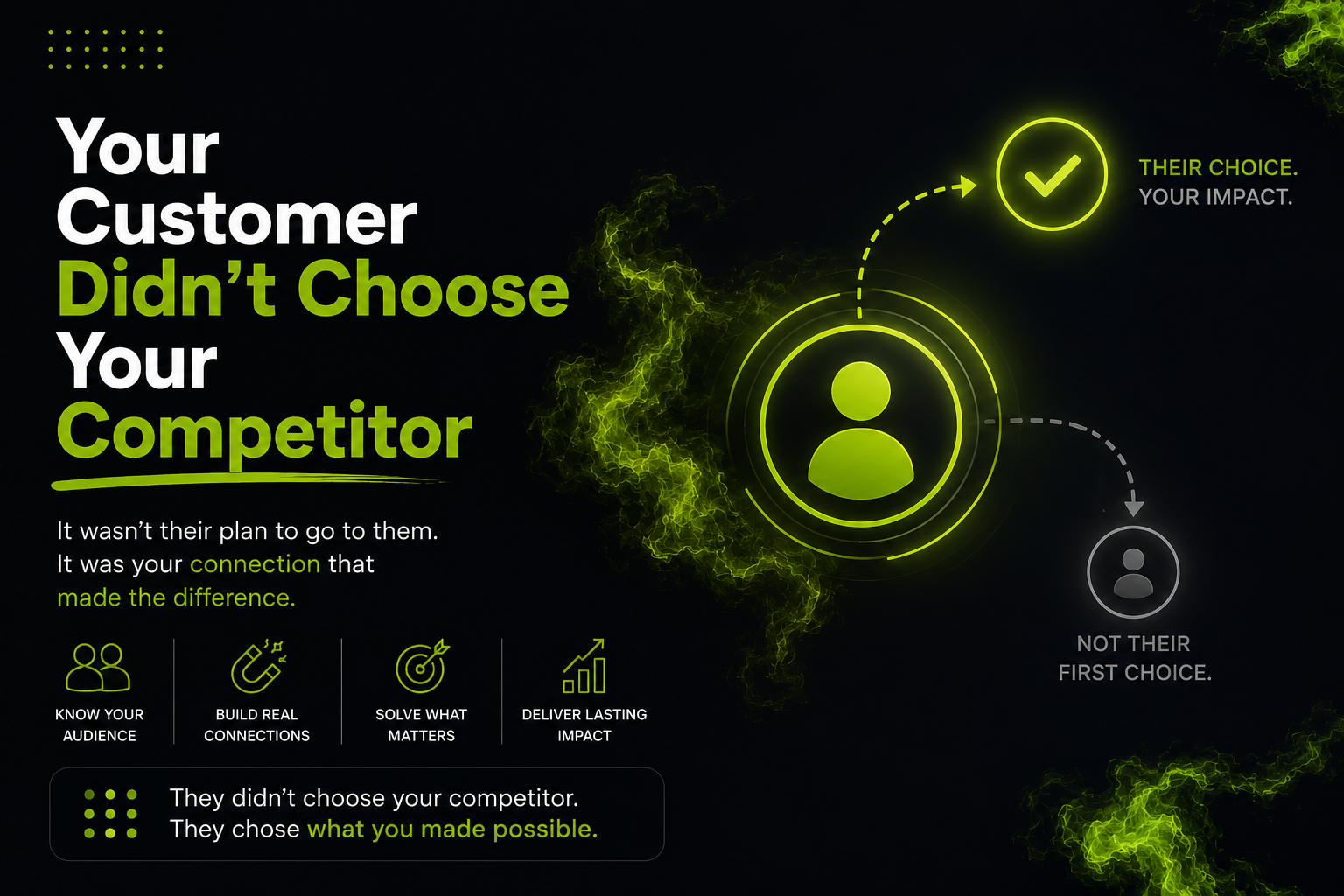
Most brands think they lose customers to competitors.
Not always.
Many times, the customer did not actively choose another brand. They simply failed to find enough clarity, trust, relevance or confidence in yours. So, they left. They compared. They delayed. They forgot. Then another brand made the decision easier.
That difference matters.
Because if you believe your competitor “won,” you will obsess over their pricing, offers, ads, creatives and social media. But if you understand that your customer got stuck somewhere in your journey, the problem becomes more useful.
You stop blaming the market.
You start fixing the path.
This is where customer decision making becomes central to digital growth. People do not buy because a brand is visible. They buy when the brand makes the decision feel clear, safe, relevant and worth acting on.
Traffic is only the arrival. Decision is the real battle.
Not always.
Many times, the customer did not actively choose another brand. They simply failed to find enough clarity, trust, relevance or confidence in yours. So, they left. They compared. They delayed. They forgot. Then another brand made the decision easier.
That difference matters.
Because if you believe your competitor “won,” you will obsess over their pricing, offers, ads, creatives and social media. But if you understand that your customer got stuck somewhere in your journey, the problem becomes more useful.
You stop blaming the market.
You start fixing the path.
This is where customer decision making becomes central to digital growth. People do not buy because a brand is visible. They buy when the brand makes the decision feel clear, safe, relevant and worth acting on.
Traffic is only the arrival. Decision is the real battle.
The Decision-Friction Map
At Anvis Digital, we look at this through the Decision-Friction Map: a way of identifying where customers lose confidence before they convert.
There are five common friction points.
First, attention friction. The customer sees your brand but does not understand why it matters.
Second, understanding friction. They visit your website or landing page but cannot quickly grasp your value, offer or difference.
Third, trust friction. They like the idea, but there is not enough proof, clarity, credibility or reassurance.
Fourth, action friction. They are interested, but the enquiry form, WhatsApp flow, page structure or call-to-action makes the next step harder than it should be.
Fifth, follow-up friction. They enquire, but the response feels slow, unclear, generic or disconnected from what brought them in.
This is why customer buying behaviour cannot be reduced to one click, one campaign, or one platform. A buyer may see your ad, search your brand, check your Instagram, visit your website, leave, compare competitors, return through remarketing, read reviews and then enquire.
The customer experiences all this as one brand.
If your marketing works in pieces, the customer feels the gaps.
There are five common friction points.
First, attention friction. The customer sees your brand but does not understand why it matters.
Second, understanding friction. They visit your website or landing page but cannot quickly grasp your value, offer or difference.
Third, trust friction. They like the idea, but there is not enough proof, clarity, credibility or reassurance.
Fourth, action friction. They are interested, but the enquiry form, WhatsApp flow, page structure or call-to-action makes the next step harder than it should be.
Fifth, follow-up friction. They enquire, but the response feels slow, unclear, generic or disconnected from what brought them in.
This is why customer buying behaviour cannot be reduced to one click, one campaign, or one platform. A buyer may see your ad, search your brand, check your Instagram, visit your website, leave, compare competitors, return through remarketing, read reviews and then enquire.
The customer experiences all this as one brand.
If your marketing works in pieces, the customer feels the gaps.
Customer Experience Is the Conversion Layer
Many brands treat customer experience as something that begins after the lead is generated.
That is too late.
Customer experience begins the moment someone discovers your brand online. Your search result is an experience. Your ad is an experience. Your landing page is an experience. Your Instagram profile is an experience. Your website speed, content structure, proof points, enquiry form and follow-up message are all part of the experience.
This is where weak digital journeys quietly lose business.
The competitor does not always need a better product. They only need a clearer path.
If your ad creates interest but your landing page creates doubt, you lose.
If your SEO brings intent but your website lacks structure, you lose.
If your social media builds attention but your enquiry process creates friction, you lose.
If your content sounds impressive but avoids real objections, you lose.
Not always to a better competitor.
Often to a clearer one.
That is too late.
Customer experience begins the moment someone discovers your brand online. Your search result is an experience. Your ad is an experience. Your landing page is an experience. Your Instagram profile is an experience. Your website speed, content structure, proof points, enquiry form and follow-up message are all part of the experience.
This is where weak digital journeys quietly lose business.
The competitor does not always need a better product. They only need a clearer path.
If your ad creates interest but your landing page creates doubt, you lose.
If your SEO brings intent but your website lacks structure, you lose.
If your social media builds attention but your enquiry process creates friction, you lose.
If your content sounds impressive but avoids real objections, you lose.
Not always to a better competitor.
Often to a clearer one.
Strategy Must Follow the Customer’s Mind
A serious digital marketing strategy does not begin with channels. It begins with the customer’s state of mind.
What do they already know?
What are they unsure about?
What alternatives are they comparing?
What proof do they need?
What would make action feel easier?
Where are they likely to drop off?
These questions should shape the website, landing pages, SEO content, paid campaigns, social communication, remarketing, analytics and conversion optimisation.
At Anvis Digital, this is the difference between activity and growth. Activity says, “Let’s run campaigns.” Growth asks, “What does the customer need to believe before this campaign can work?”
That one question changes everything.
Because launch day does not create campaign quality. It reveals it.
If the message is weak, media spend exposes it. If the website is unclear, traffic exposes it. If the offer lacks relevance, performance data exposes it. If the customer journey has friction, competitors benefit from it.
What do they already know?
What are they unsure about?
What alternatives are they comparing?
What proof do they need?
What would make action feel easier?
Where are they likely to drop off?
These questions should shape the website, landing pages, SEO content, paid campaigns, social communication, remarketing, analytics and conversion optimisation.
At Anvis Digital, this is the difference between activity and growth. Activity says, “Let’s run campaigns.” Growth asks, “What does the customer need to believe before this campaign can work?”
That one question changes everything.
Because launch day does not create campaign quality. It reveals it.
If the message is weak, media spend exposes it. If the website is unclear, traffic exposes it. If the offer lacks relevance, performance data exposes it. If the customer journey has friction, competitors benefit from it.
Your Competitor May Not Be Better
Your competitor may not have a stronger product. They may not have better service. They may not even have better marketing.
They may simply be easier to understand.
That is the uncomfortable part.
Customers often move toward the brand that gives them fewer reasons to hesitate: clearer messaging, sharper landing pages, stronger proof, better-timed media, relevant content, cleaner website flow and simpler next steps.
So, the real question is not, “Why did the customer choose them?”
The better question is, “Where did we make the decision harder?”
Anvis Digital helps brands answer that question by connecting strategy, SEO, paid media, content, websites, landing pages, social media, analytics and conversion optimisation into one growth system.
Because connected digital growth is not about being everywhere.
It is about making every touchpoint help the customer move forward.
Your competitor did not always win the customer.
Sometimes, your brand simply made the decision too hard.
They may simply be easier to understand.
That is the uncomfortable part.
Customers often move toward the brand that gives them fewer reasons to hesitate: clearer messaging, sharper landing pages, stronger proof, better-timed media, relevant content, cleaner website flow and simpler next steps.
So, the real question is not, “Why did the customer choose them?”
The better question is, “Where did we make the decision harder?”
Anvis Digital helps brands answer that question by connecting strategy, SEO, paid media, content, websites, landing pages, social media, analytics and conversion optimisation into one growth system.
Because connected digital growth is not about being everywhere.
It is about making every touchpoint help the customer move forward.
Your competitor did not always win the customer.
Sometimes, your brand simply made the decision too hard.
FAQs
1. Why do customers choose competitors online?
Customers often choose competitors because the competitor feels clearer, safer, easier to trust or simpler to act on. The issue is not always price or visibility. It is often decision friction.
2. How does customer decision making affect digital marketing?
Customer decision making affects how people respond to ads, websites, landing pages, social media, content and follow-up. If a brand does not reduce uncertainty, customers may compare, delay or leave.
3. Why is customer experience important before conversion?
Customer experience begins before the sale. Search results, ads, landing pages, websites, forms and responses all influence whether a customer feels confident enough to enquire or buy.
4. How can Anvis Digital improve digital growth?
Anvis Digital connects strategy, SEO, paid media, content, websites, landing pages, social media, analytics and conversion optimisation so brands reduce decision friction and create clearer customer journeys.