

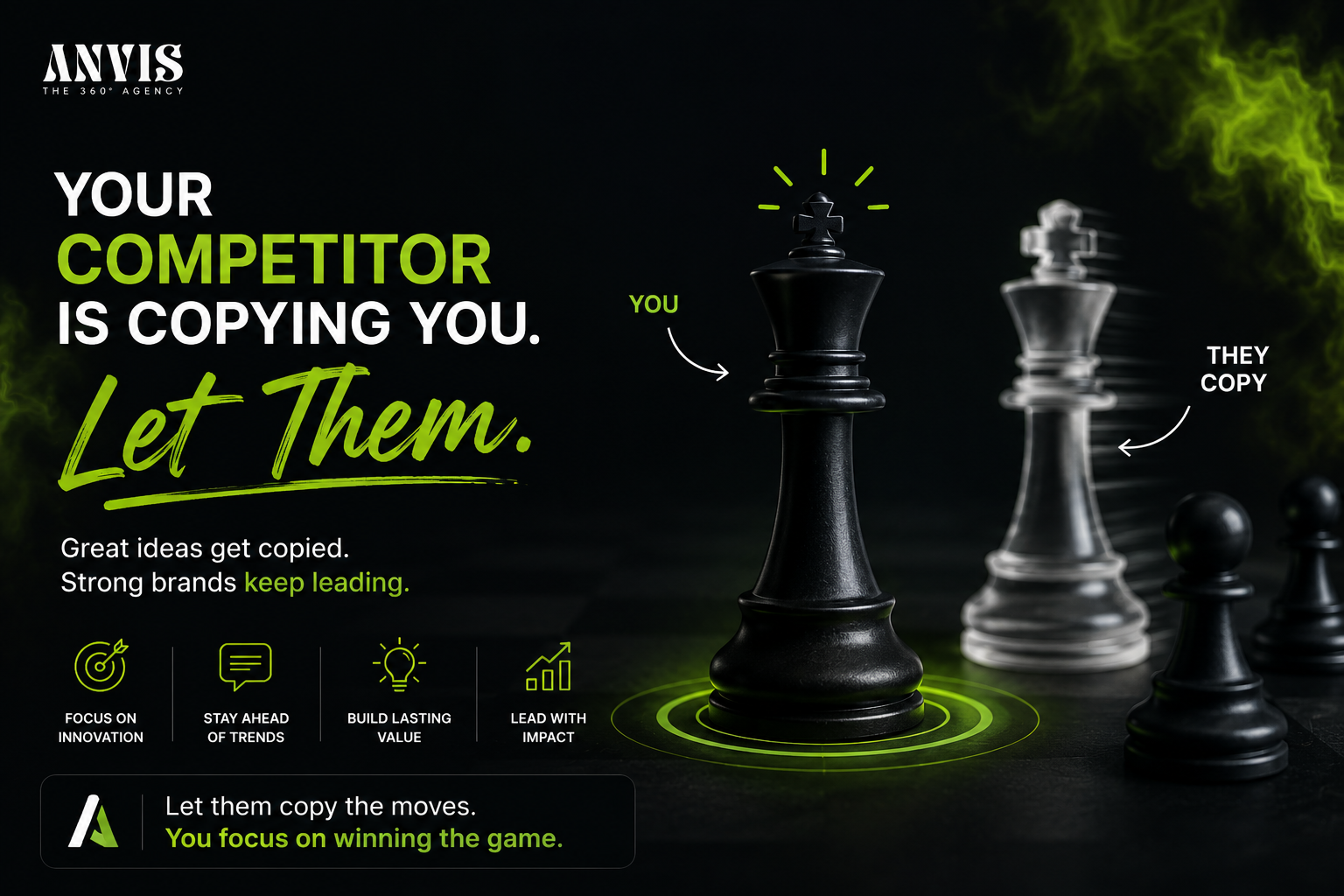
When a competitor starts copying your campaigns, content style, ad formats, website language or social media ideas, the first reaction is usually irritation.
Fair. Nobody likes watching their thinking show up in someone else’s feed.
But here is the sharper truth: if your competitor can copy it easily, it was probably never your strongest asset.
They can copy the visible layer. The carousel format. The landing page structure. The hook. The headline rhythm. The colour mood. The content category. Even the campaign idea.
With ai in marketing, imitation has become cheaper, faster and more convincing. A brand can now study your public presence, generate similar content and launch lookalike campaigns in days.
But AI has made imitation easier. It has not made brand thinking easier.
That is where the real advantage sits.
Fair. Nobody likes watching their thinking show up in someone else’s feed.
But here is the sharper truth: if your competitor can copy it easily, it was probably never your strongest asset.
They can copy the visible layer. The carousel format. The landing page structure. The hook. The headline rhythm. The colour mood. The content category. Even the campaign idea.
With ai in marketing, imitation has become cheaper, faster and more convincing. A brand can now study your public presence, generate similar content and launch lookalike campaigns in days.
But AI has made imitation easier. It has not made brand thinking easier.
That is where the real advantage sits.
Copying Exposes What Your Brand Is Built On
The real issue is not that competitors copy. The real issue is what they can copy.
If they copy your visuals, that is design.
If they copy your content format, that is execution.
If they copy your ad angle, that is campaign surface.
If they copy your tone, that is communication style.
None of this is meaningless. But none of it is enough.
A strong brand is not protected because nobody can imitate its assets. It is protected because those assets come from a deeper strategic system competitors cannot understand from the outside.
That system begins with brand positioning.
Without clear brand positioning, every brand looks busy but sounds replaceable. Campaigns happen. Posts go live. Ads run. Reports get created. But the customer still cannot answer the most important question: “Why should I choose this brand over another?”
Anvis Digital looks at growth from that point of tension. Before amplification, there has to be clarity. Before traffic, there must be meaning. Before media spend, there has to be a reason for the customer to care.
If they copy your visuals, that is design.
If they copy your content format, that is execution.
If they copy your ad angle, that is campaign surface.
If they copy your tone, that is communication style.
None of this is meaningless. But none of it is enough.
A strong brand is not protected because nobody can imitate its assets. It is protected because those assets come from a deeper strategic system competitors cannot understand from the outside.
That system begins with brand positioning.
Without clear brand positioning, every brand looks busy but sounds replaceable. Campaigns happen. Posts go live. Ads run. Reports get created. But the customer still cannot answer the most important question: “Why should I choose this brand over another?”
Anvis Digital looks at growth from that point of tension. Before amplification, there has to be clarity. Before traffic, there must be meaning. Before media spend, there has to be a reason for the customer to care.
The Surface-to-System Advantage
Competitors can copy outputs. They struggle to copy the operating logic behind them.
At Anvis Digital, this is where the surface-to-system advantage matters. It looks at five layers that make a brand harder to imitate.
First, customer insight. What does the audience doubt, compare, fear, desire, misunderstand or postpone?
Second, message hierarchy. What must the customer understand first, second and third before they are ready to act?
Third, digital journey. Does your website, landing page, social media, SEO content and paid media experience move the customer forward or does it create friction?
Fourth, media intelligence. Where is attention being wasted? Which channel builds trust, which channel captures demand and which audience stage needs a different message?
Fifth, measurement discipline. Are you tracking vanity metrics or are you learning what improves business outcomes?
This is where digital branding becomes more than appearance. It becomes the way your brand behaves across search, social, paid campaigns, landing pages, website experience, content and reporting.
A competitor can copy one touchpoint. They cannot easily copy the connected logic across all touchpoints.
At Anvis Digital, this is where the surface-to-system advantage matters. It looks at five layers that make a brand harder to imitate.
First, customer insight. What does the audience doubt, compare, fear, desire, misunderstand or postpone?
Second, message hierarchy. What must the customer understand first, second and third before they are ready to act?
Third, digital journey. Does your website, landing page, social media, SEO content and paid media experience move the customer forward or does it create friction?
Fourth, media intelligence. Where is attention being wasted? Which channel builds trust, which channel captures demand and which audience stage needs a different message?
Fifth, measurement discipline. Are you tracking vanity metrics or are you learning what improves business outcomes?
This is where digital branding becomes more than appearance. It becomes the way your brand behaves across search, social, paid campaigns, landing pages, website experience, content and reporting.
A competitor can copy one touchpoint. They cannot easily copy the connected logic across all touchpoints.
Creative Communication Is Not Decoration
Good creative communication is not about being louder, funnier or more stylish than competitors. It is about making the customer feel, “This brand understands the problem better.”
That kind of communication cannot be copied by lifting the words.
A competitor may copy your headline. They cannot copy the customer tension that created it. They may copy your landing page sections. They cannot copy the conversion logic behind the order. They may copy your ad format. They cannot copy the media intelligence behind where, when, and why that message was placed.
This is where Anvis Digital connected-growth approach becomes important. SEO is not treated as ranking alone. Paid media is not treated as distribution alone. Content is not treated as posting alone. Website design is not treated as visual polish alone.
Each service must support the same strategic meaning.
The execution can change. The meaning cannot.
That kind of communication cannot be copied by lifting the words.
A competitor may copy your headline. They cannot copy the customer tension that created it. They may copy your landing page sections. They cannot copy the conversion logic behind the order. They may copy your ad format. They cannot copy the media intelligence behind where, when, and why that message was placed.
This is where Anvis Digital connected-growth approach becomes important. SEO is not treated as ranking alone. Paid media is not treated as distribution alone. Content is not treated as posting alone. Website design is not treated as visual polish alone.
Each service must support the same strategic meaning.
The execution can change. The meaning cannot.
Build a Brand They Can Copy and Still Lose To
A serious competitive marketing strategy is not built around watching competitors every day. That is reactive, exhausting and usually unprofitable.
The better strategy is to become harder to replace.
That means building a unique brand identity that is not limited to logos, colours, and templates. It should show up in how your brand explains value, handles objections, structures website journeys, plans media, builds content, measures performance and earns trust before the sale.
If customers remember your brand only because it looked different once, your advantage is fragile.
If customers remember your brand because every interaction made the choice clearer, your advantage compounds.
So let competitors copy the surface.
Let them chase your formats, hooks, campaigns and visible moves.
Then outgrow them with sharper positioning, stronger customer insight, better media intelligence, clearer communication, stronger digital infrastructure and a connected growth system they cannot reverse-engineer from the outside.
The strongest brands are not the ones nobody copies.
They are the ones competitors can copy and still fail to catch.
The better strategy is to become harder to replace.
That means building a unique brand identity that is not limited to logos, colours, and templates. It should show up in how your brand explains value, handles objections, structures website journeys, plans media, builds content, measures performance and earns trust before the sale.
If customers remember your brand only because it looked different once, your advantage is fragile.
If customers remember your brand because every interaction made the choice clearer, your advantage compounds.
So let competitors copy the surface.
Let them chase your formats, hooks, campaigns and visible moves.
Then outgrow them with sharper positioning, stronger customer insight, better media intelligence, clearer communication, stronger digital infrastructure and a connected growth system they cannot reverse-engineer from the outside.
The strongest brands are not the ones nobody copies.
They are the ones competitors can copy and still fail to catch.
FAQs
1. What should a brand do when competitors copy its marketing?
A brand should avoid reacting emotionally and instead strengthen its positioning, messaging, customer journey, website experience, content strategy, media intelligence and performance measurement. The goal is to build a system competitors cannot copy easily.
2. Why is brand positioning important when competitors copy you?
Brand positioning gives customers a clear reason to choose your brand. Without it, competitors can copy your visible marketing and make you look replaceable.
3. How does digital branding help with differentiation?
Digital branding creates consistency across SEO, paid media, social media, websites, landing pages, content and analytics. It helps customers experience one clear brand meaning across multiple touchpoints.
4. How can Anvis Digital help brands become harder to copy?
Anvis Digital helps brands connect positioning, messaging, media, websites, content, SEO, paid campaigns and analytics into one growth system, so competitors can copy visible assets but not the strategic logic behind them.