

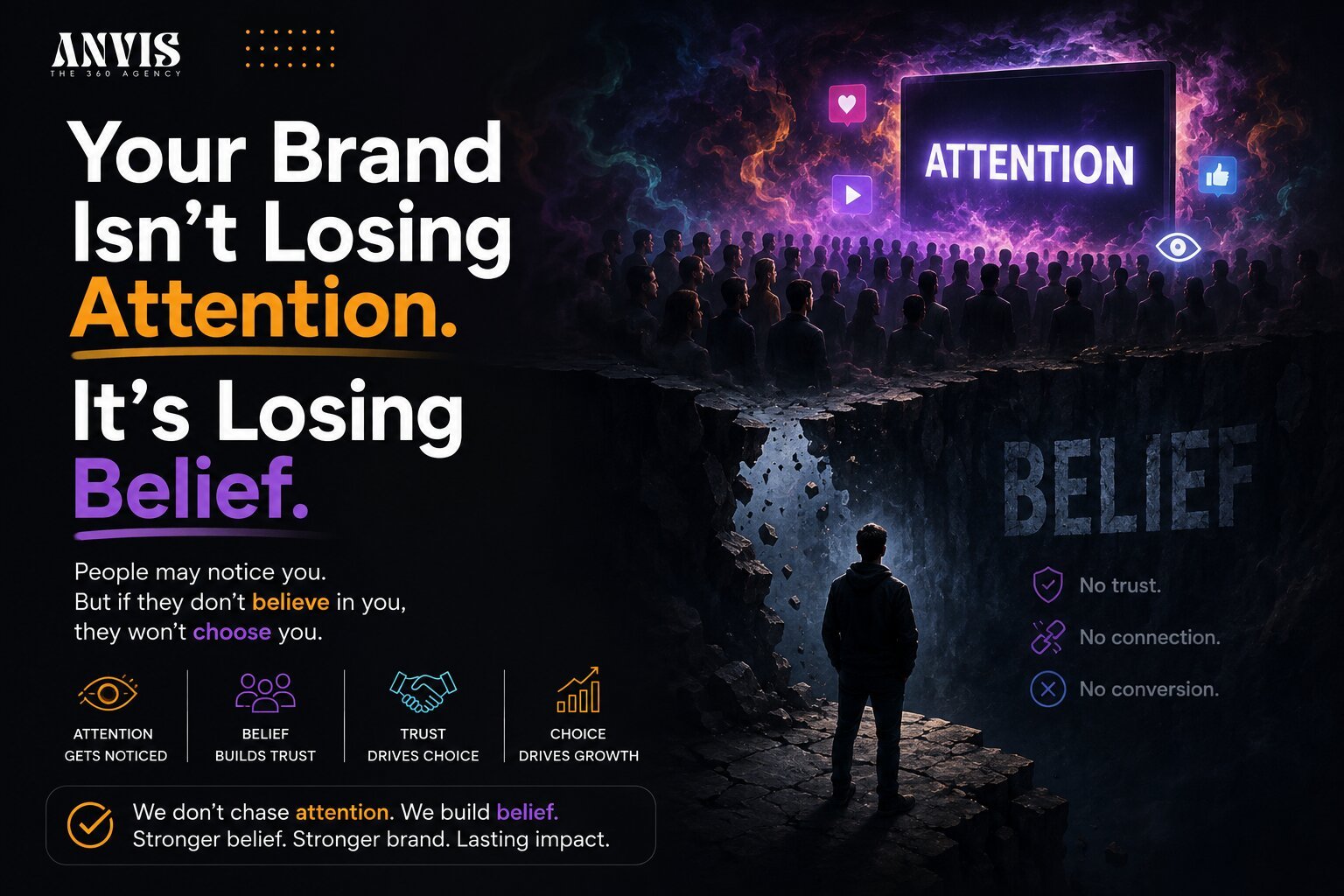
Most businesses think their biggest marketing challenge is getting noticed.
It often isn’t.
People are seeing your ads. They are visiting your website. They are reading your content. They are comparing your brand.
Then they leave.
The problem is rarely attention. It is belief.
Customers do not buy because they noticed you. They buy because they trust what they noticed. When marketing creates curiosity but fails to create confidence, every click becomes more expensive, and every campaign delivers less than it should.
If you want to build brand trust, stop asking, “How do we reach more people?” and start asking, “Why aren’t the people already reaching us choosing us?”
It often isn’t.
People are seeing your ads. They are visiting your website. They are reading your content. They are comparing your brand.
Then they leave.
The problem is rarely attention. It is belief.
Customers do not buy because they noticed you. They buy because they trust what they noticed. When marketing creates curiosity but fails to create confidence, every click becomes more expensive, and every campaign delivers less than it should.
If you want to build brand trust, stop asking, “How do we reach more people?” and start asking, “Why aren’t the people already reaching us choosing us?”
The Hidden Reality
The hidden reality is this: brands rarely lose customers because they are invisible. They lose them because they feel uncertain.
A polished advertisement leads to an outdated website. Helpful SEO content ends with generic messaging. A compelling social media post sends visitors to a confusing landing page. Reviews go unanswered. Proof is difficult to find.
Each issue seems small.
Together, they quietly weaken customer trust
Customers rarely announce that they stopped believing your brand. They simply stop moving forward.
Traffic is only the arrival.
Belief determines whether the journey continues.
A polished advertisement leads to an outdated website. Helpful SEO content ends with generic messaging. A compelling social media post sends visitors to a confusing landing page. Reviews go unanswered. Proof is difficult to find.
Each issue seems small.
Together, they quietly weaken customer trust
Customers rarely announce that they stopped believing your brand. They simply stop moving forward.
Traffic is only the arrival.
Belief determines whether the journey continues.
The Anvis Belief Chain
At Anvis Digital, we see belief as a chain. Customers rarely make one big decision—they make a series of smaller decisions before saying “yes.” Break one link, and confidence weakens.
The first link is Instant Understanding. Customers should immediately understand what your business does, who it helps, and why it matters. Every second spent decoding your message increases hesitation.
The second link is Reason to Believe. Customers look for evidence before they believe claims. Reviews, case studies, expertise, testimonials and consistent messaging answer the question: *Why should I trust this brand?*
The third link is Proof in Every Touchpoint. Your website, search presence, content, social media, landing pages and conversations should all reinforce the same promise. Consistency is not repetition—it is confirmation.
The final link is Decision Ease. When the first three links work together, customers stop searching for reasons to leave and start feeling comfortable enough to move forward.
This is how brand reputation grows—not through isolated campaigns, but through connected experiences that strengthen belief before every decision.
The first link is Instant Understanding. Customers should immediately understand what your business does, who it helps, and why it matters. Every second spent decoding your message increases hesitation.
The second link is Reason to Believe. Customers look for evidence before they believe claims. Reviews, case studies, expertise, testimonials and consistent messaging answer the question: *Why should I trust this brand?*
The third link is Proof in Every Touchpoint. Your website, search presence, content, social media, landing pages and conversations should all reinforce the same promise. Consistency is not repetition—it is confirmation.
The final link is Decision Ease. When the first three links work together, customers stop searching for reasons to leave and start feeling comfortable enough to move forward.
This is how brand reputation grows—not through isolated campaigns, but through connected experiences that strengthen belief before every decision.
Authority Is Earned Before It Is Claimed
Many businesses describe themselves as industry leaders.
Customers decide whether that claim is true.
Real brand authority comes from repeated proof, not repeated promotion.
It is earned by publishing meaningful insights instead of generic advice, answering customer questions before they are asked and consistently delivering experiences that match expectations.
That is why effective digital marketing should do more than generate visibility.
It should remove doubt.
Attention attracts visitors.
Authority gives them confidence to stay.
Customers decide whether that claim is true.
Real brand authority comes from repeated proof, not repeated promotion.
It is earned by publishing meaningful insights instead of generic advice, answering customer questions before they are asked and consistently delivering experiences that match expectations.
That is why effective digital marketing should do more than generate visibility.
It should remove doubt.
Attention attracts visitors.
Authority gives them confidence to stay.
Your Reputation Is Working Even When You Aren't
Years ago, reputation spread through conversations.
Today, it spreads through search results, reviews, articles, videos, LinkedIn posts and customer experiences.
Your online reputation influences decisions long before someone contacts your business.
Customers research before they enquire.
They compare before they commit.
They validate before they trust.
If your digital presence creates unanswered questions, competitors do not need a better product.
They simply need to create fewer doubts.
This is why reputation should be managed proactively, not only when something goes wrong.
Today, it spreads through search results, reviews, articles, videos, LinkedIn posts and customer experiences.
Your online reputation influences decisions long before someone contacts your business.
Customers research before they enquire.
They compare before they commit.
They validate before they trust.
If your digital presence creates unanswered questions, competitors do not need a better product.
They simply need to create fewer doubts.
This is why reputation should be managed proactively, not only when something goes wrong.
Belief Is the Real Growth Strategy
Businesses often invest in more campaigns when growth slows.
The better investment is strengthening belief.
When customers instantly understand your value, find credible proof, experience consistency across every interaction and feel confident enough to act, growth becomes easier to sustain.
That is how Anvis Digital approaches growth—not as disconnected marketing activities, but as a connected system that removes doubt before customers are forced to decide.
The strongest brands are not remembered because they attracted the most attention.
They are remembered because they made the next decision feel easier.
Your brand is not always losing attention.
It is often losing belief long before it loses the sale.
Because growth rarely belongs to the loudest brand.
It belongs to the brand that removes uncertainty before the customer has a reason to walk away.
The better investment is strengthening belief.
When customers instantly understand your value, find credible proof, experience consistency across every interaction and feel confident enough to act, growth becomes easier to sustain.
That is how Anvis Digital approaches growth—not as disconnected marketing activities, but as a connected system that removes doubt before customers are forced to decide.
The strongest brands are not remembered because they attracted the most attention.
They are remembered because they made the next decision feel easier.
Your brand is not always losing attention.
It is often losing belief long before it loses the sale.
Because growth rarely belongs to the loudest brand.
It belongs to the brand that removes uncertainty before the customer has a reason to walk away.
FAQs
1. Why is customer trust more important than visibility?
Visibility attracts attention, but customer trust influences buying decisions. Without trust, even successful campaigns struggle to convert interest into enquiries and sales.
2. How can businesses build brand trust online?
To build brand trust, businesses should create consistent messaging, publish valuable content, showcase proof, improve website experience, respond to reviews and maintain a seamless customer journey.
3. Why is online reputation important for business growth?
A strong online reputation reassures potential customers before they enquire. Search results, reviews, content and social proof all influence buying confidence.
4. How does Anvis Digital strengthen brand authority?
Anvis Digital helps businesses reduce customer doubt, increase decision confidence, and strengthen long-term trust by connecting strategy, messaging, content, SEO, websites, paid media, analytics and customer experience into one coordinated growth system.