

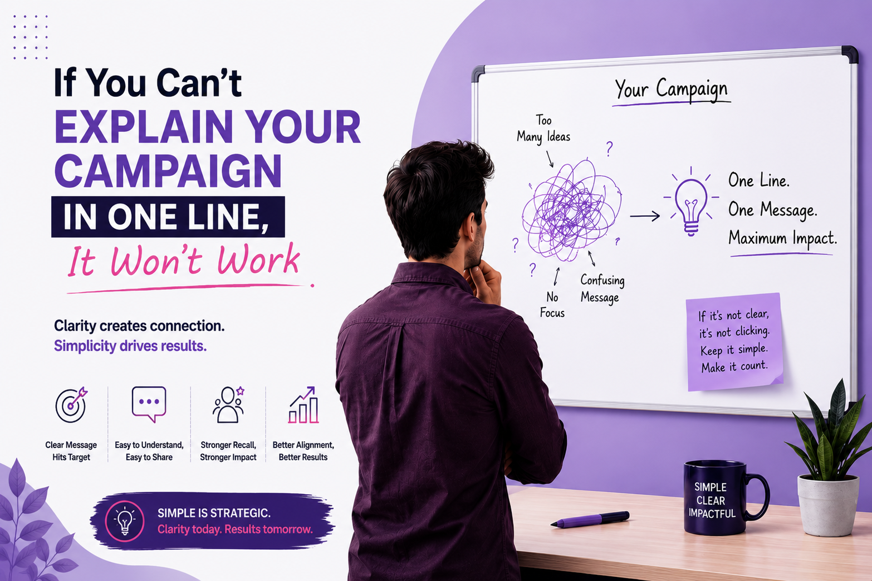
A campaign can have a beautiful design, a clever headline, a high media spends, ten content formats, a landing page, reels, banners, search ads, influencer legs, email flows and outdoor visibility.
But if the core idea cannot be explained in one clear line, the campaign is already leaking attention.
In today’s marketing environment, audiences are not patiently decoding brand communication. They are scrolling, skipping, comparing, multitasking and forgetting faster than brands can publish. This is why a strong advertising campaign strategy does not begin with channels, formats or budgets. It begins with clarity.
Before a campaign travels across media, it must first survive one simple question:
What are we trying to say?
But if the core idea cannot be explained in one clear line, the campaign is already leaking attention.
In today’s marketing environment, audiences are not patiently decoding brand communication. They are scrolling, skipping, comparing, multitasking and forgetting faster than brands can publish. This is why a strong advertising campaign strategy does not begin with channels, formats or budgets. It begins with clarity.
Before a campaign travels across media, it must first survive one simple question:
What are we trying to say?
The One-Line Test Every Campaign Must Pass
Every successful campaign has a central idea that can be understood quickly.
Not a paragraph.
Not a presentation deck.
Not a strategy document filled with jargon.
One line.
This one line is not necessarily the public-facing tagline. It is the strategic spine of the campaign. It tells the team what the campaign is about, who it is for, why it matters and what the audience should remember.
For example, a weak campaign thought may sound like:
“We want to create awareness around our product benefits while increasing engagement across multiple audience segments.”
That may be technically correct, but it is not memorable.
A stronger campaign idea would be:
“Make busy parents see this snack as the easiest healthy choice for their children.”
Now the campaign has direction. The creative team knows what to express. The media team knows who to target. The content team knows what emotion to build. The performance team knows what conversion intent to capture.
This is where clear brand messaging becomes the difference between scattered marketing and connected growth.
Not a paragraph.
Not a presentation deck.
Not a strategy document filled with jargon.
One line.
This one line is not necessarily the public-facing tagline. It is the strategic spine of the campaign. It tells the team what the campaign is about, who it is for, why it matters and what the audience should remember.
For example, a weak campaign thought may sound like:
“We want to create awareness around our product benefits while increasing engagement across multiple audience segments.”
That may be technically correct, but it is not memorable.
A stronger campaign idea would be:
“Make busy parents see this snack as the easiest healthy choice for their children.”
Now the campaign has direction. The creative team knows what to express. The media team knows who to target. The content team knows what emotion to build. The performance team knows what conversion intent to capture.
This is where clear brand messaging becomes the difference between scattered marketing and connected growth.
Confusion Multiplies Across Channels
Many campaigns do not fail because the idea is bad. They fail because the idea becomes unclear as it moves across platforms.
A brand may start with one campaign objective, but by the time it appears on Instagram, Google, YouTube, WhatsApp, print, outdoor, email and landing pages, the message starts wearing too many costumes.
One platform says, “premium quality.”
Another says, “limited offer.”
Another says, “trusted by experts.”
Another says, “new launch.”
Another says, “affordable choice.”
Each message may be useful individually, but together they create noise.
This is especially dangerous in multichannel advertising, where every touchpoint must feel connected without becoming repetitive. The goal is not to copy-paste the same sentence everywhere. The goal is to make every channel serve the same campaign thought.
A reel may create emotion.
A search ad may capture intent.
An email may explain value.
A landing page may convert.
A billboard may build recall.
But all of them should point back to the same central idea.
That is how campaigns compound. Without that, brands are simply buying visibility without building memory.
A brand may start with one campaign objective, but by the time it appears on Instagram, Google, YouTube, WhatsApp, print, outdoor, email and landing pages, the message starts wearing too many costumes.
One platform says, “premium quality.”
Another says, “limited offer.”
Another says, “trusted by experts.”
Another says, “new launch.”
Another says, “affordable choice.”
Each message may be useful individually, but together they create noise.
This is especially dangerous in multichannel advertising, where every touchpoint must feel connected without becoming repetitive. The goal is not to copy-paste the same sentence everywhere. The goal is to make every channel serve the same campaign thought.
A reel may create emotion.
A search ad may capture intent.
An email may explain value.
A landing page may convert.
A billboard may build recall.
But all of them should point back to the same central idea.
That is how campaigns compound. Without that, brands are simply buying visibility without building memory.
Creativity Becomes Stronger When Strategy is Simpler
There is a myth that clarity kills creativity.
Clarity gives creativity sharper teeth.
When a campaign idea is vague, creative teams must guess. They produce multiple directions, multiple tones and multiple interpretations. The result may look visually impressive, but it often feels inconsistent.
When the campaign idea is clear, creativity becomes more powerful because everyone is solving the same problem.
A simple campaign thought can become:
That is the true role of an integrated agency. Not just to create assets, but to create alignment.
Clarity gives creativity sharper teeth.
When a campaign idea is vague, creative teams must guess. They produce multiple directions, multiple tones and multiple interpretations. The result may look visually impressive, but it often feels inconsistent.
When the campaign idea is clear, creativity becomes more powerful because everyone is solving the same problem.
A simple campaign thought can become:
- A bold headline
- A memorable visual device
- A social media content series
- A landing page narrative
- A performance ad hook
- A video script
- An outdoor campaign
- A customer journey
That is the true role of an integrated agency. Not just to create assets, but to create alignment.
The Hidden Reality: Brands Don’t Need More Campaigns, They Need Better Connected Campaigns
Many brands today are running too many disconnected marketing activities.
Social media is active.
Ads are running.
The website exists.
Emails are being sent.
Influencers are being explored.
Reports are being generated.
But the audience still does not remember what the brand stands for.
This is the hidden reality of modern marketing: activity is not the same as impact.
A campaign works when brand storytelling, digital infrastructure, creative execution, media intelligence and measurement all move in one direction.That is where Anvis Digital brings stronger value as a connected digital growth partner.
The focus should not only be: “How many channels are we using?”
The better question is:
“Is every channel helping the audience remember the same thing?”
Because once the message is clear, everything else becomes sharper.
The website converts better.
The ads perform better.
The content feels more consistent.
The media spend becomes more efficient.
The brand becomes easier to recall.
Social media is active.
Ads are running.
The website exists.
Emails are being sent.
Influencers are being explored.
Reports are being generated.
But the audience still does not remember what the brand stands for.
This is the hidden reality of modern marketing: activity is not the same as impact.
A campaign works when brand storytelling, digital infrastructure, creative execution, media intelligence and measurement all move in one direction.That is where Anvis Digital brings stronger value as a connected digital growth partner.
The focus should not only be: “How many channels are we using?”
The better question is:
“Is every channel helping the audience remember the same thing?”
Because once the message is clear, everything else becomes sharper.
The website converts better.
The ads perform better.
The content feels more consistent.
The media spend becomes more efficient.
The brand becomes easier to recall.
Conclusion
If a campaign cannot be explained in one line, it is not ready to go live.
That one line is the campaign’s compass. It protects the brand from scattered execution, confused messaging and wasted media spend. It helps teams align, audiences understand and channels work together.
In a crowded digital world, complexity is easy. Clarity is the real advantage.
And the brands that win are not always the ones shouting the loudest.
They are the ones saying one thing clearly enough, consistently enough and intelligently enough for people to remember.
That one line is the campaign’s compass. It protects the brand from scattered execution, confused messaging and wasted media spend. It helps teams align, audiences understand and channels work together.
In a crowded digital world, complexity is easy. Clarity is the real advantage.
And the brands that win are not always the ones shouting the loudest.
They are the ones saying one thing clearly enough, consistently enough and intelligently enough for people to remember.