

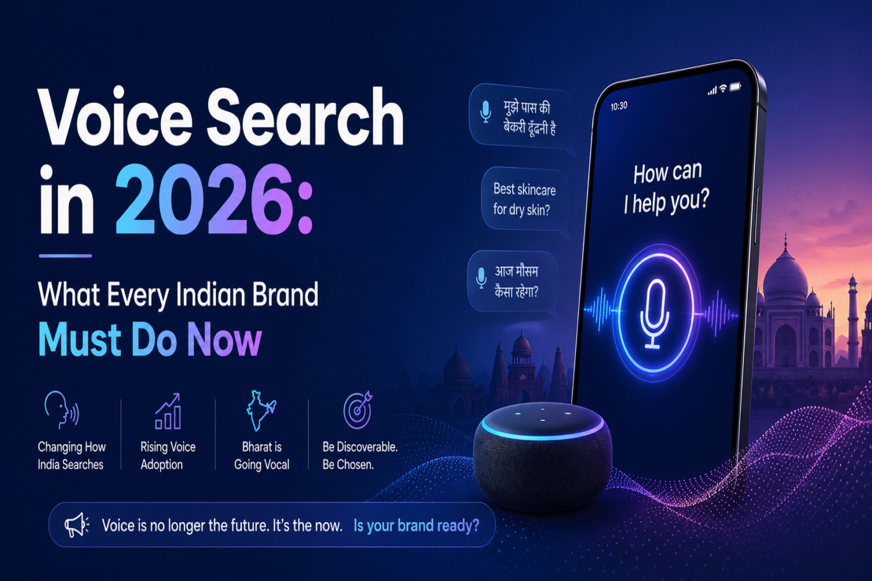
Voice search has already crossed the tipping point, but the real disruption is not adoption. It is selection control.
Today, when a user asks a voice assistant a question, over 65% of responses are pulled from featured snippets or structured answer boxes. That means the competition is no longer about ranking. It is about being the one result that gets chosen.
Most brands are still playing the old game.
For businesses investing in digital marketing solutions, the shift is clear: visibility is no longer earned through presence. It is earned through precision.
Today, when a user asks a voice assistant a question, over 65% of responses are pulled from featured snippets or structured answer boxes. That means the competition is no longer about ranking. It is about being the one result that gets chosen.
Most brands are still playing the old game.
For businesses investing in digital marketing solutions, the shift is clear: visibility is no longer earned through presence. It is earned through precision.
The Structural Shift: From SEO to Answer Systems
Traditional SEO rewards pages. Voice search rewards systems of answers.
Search engines now prioritize content that can:
This is where the role of a SEO agency in Mumbai fundamentally changes. The focus is no longer on optimizing pages individually. It is on building connected answer-ecosystems.
If your content cannot be broken down into clear, structured responses, it will not be selected.
Search engines now prioritize content that can:
- Deliver clarity instantly
- Be extracted without friction
- Demonstrate topical authority
This is where the role of a SEO agency in Mumbai fundamentally changes. The focus is no longer on optimizing pages individually. It is on building connected answer-ecosystems.
If your content cannot be broken down into clear, structured responses, it will not be selected.
Why India is Driving Voice Search Faster Than Expected?
India is not just adapting to voice search. It is accelerating it through behaviour.
-
Language Fluidity
Users naturally mix English with Hindi, Marathi, Tamil and other languages. Voice enables this seamlessly. -
Mobile Dependency
With over 90% of users accessing the internet via mobile, speaking becomes the fastest interaction method. -
Real-Life Context
Voice is used in motion: while commuting, shopping or multitasking. It aligns with real-world behaviour far better than typing.
This means SEO services must evolve beyond keyword targeting into behavioural intent mapping.
- Old SEO: “Best restaurant Mumbai”
- Voice SEO: “Best restaurant near me open now with family seating”
The P.I.C.K. System: How Brands Get Chosen
To win in voice search, brands need a tighter, execution-driven model.
The first 2–3 lines of your content must directly answer the query.
Before (losing structure):
Long introduction → delayed answer
After (winning structure):
Direct answer → supporting explanation → deeper context
Voice assistants prioritize clarity over storytelling.
Every query has layers:
Example:
Content must be designed for extraction.
Winning pages include:
This is where advanced SEO services shift from optimization to content engineering.
Voice search favours sources that demonstrate depth, not surface coverage.
Real example (anonymized):
A Mumbai-based service brand restructured its content into:
P — Precision Answers First
The first 2–3 lines of your content must directly answer the query.
Before (losing structure):
Long introduction → delayed answer
After (winning structure):
Direct answer → supporting explanation → deeper context
Voice assistants prioritize clarity over storytelling.
I — Intent Layer Mapping
Every query has layers:
- Informational
- Comparative
- Transactional
Example:
- “What is SEO?”
- “Best SEO agency in Mumbai?”
- “Affordable SEO services near me”
C — Contextual Structuring
Content must be designed for extraction.
Winning pages include:
- Question-based headings
- Bullet-point answers
- Short, precise explanations
This is where advanced SEO services shift from optimization to content engineering.
K — Knowledge Authority
Voice search favours sources that demonstrate depth, not surface coverage.
Real example (anonymized):
A Mumbai-based service brand restructured its content into:
- Core service pages
- 15+ supporting blogs answering specific queries
- FAQ schema across pages
- 38% increase in featured snippet visibility
- 22% increase in organic conversions
- Multiple queries triggering voice assistant responses
What Actually Happens When a User Searches?
Let’s breakdown a real scenario.
Query: “Best digital marketing agency near me for SEO services”
Google evaluates:
A generic page with keywords but no structure does not.
Even if it ranks.
Query: “Best digital marketing agency near me for SEO services”
Google evaluates:
- Local relevance (distance, listings)
- Content clarity (does the page answer the query instantly?)
- Authority (depth of related content)
- Structure (can this be extracted easily?)
A generic page with keywords but no structure does not.
Even if it ranks.
The Real Advantage: Systems Over Campaigns
Most brands still treat SEO as a campaign. Voice search rewards systems.
Winning brands:
Winning brands:
- Build interconnected content clusters
- Maintain consistent publishing
- Optimize for intent, not just traffic
- Structure every page for extraction
What This Means for Your Brand?
Voice search is no longer a feature. It is a filter that decides which brands are seen and which are ignored.
The shift is clear:
Because in 2026, the brands that win are not the ones that appear everywhere.
They are the ones that get chosen instantly, without competition.
The shift is clear:
- From ranking → to selection
- From keywords → to intent
- From pages → to answer systems
Because in 2026, the brands that win are not the ones that appear everywhere.
They are the ones that get chosen instantly, without competition.