

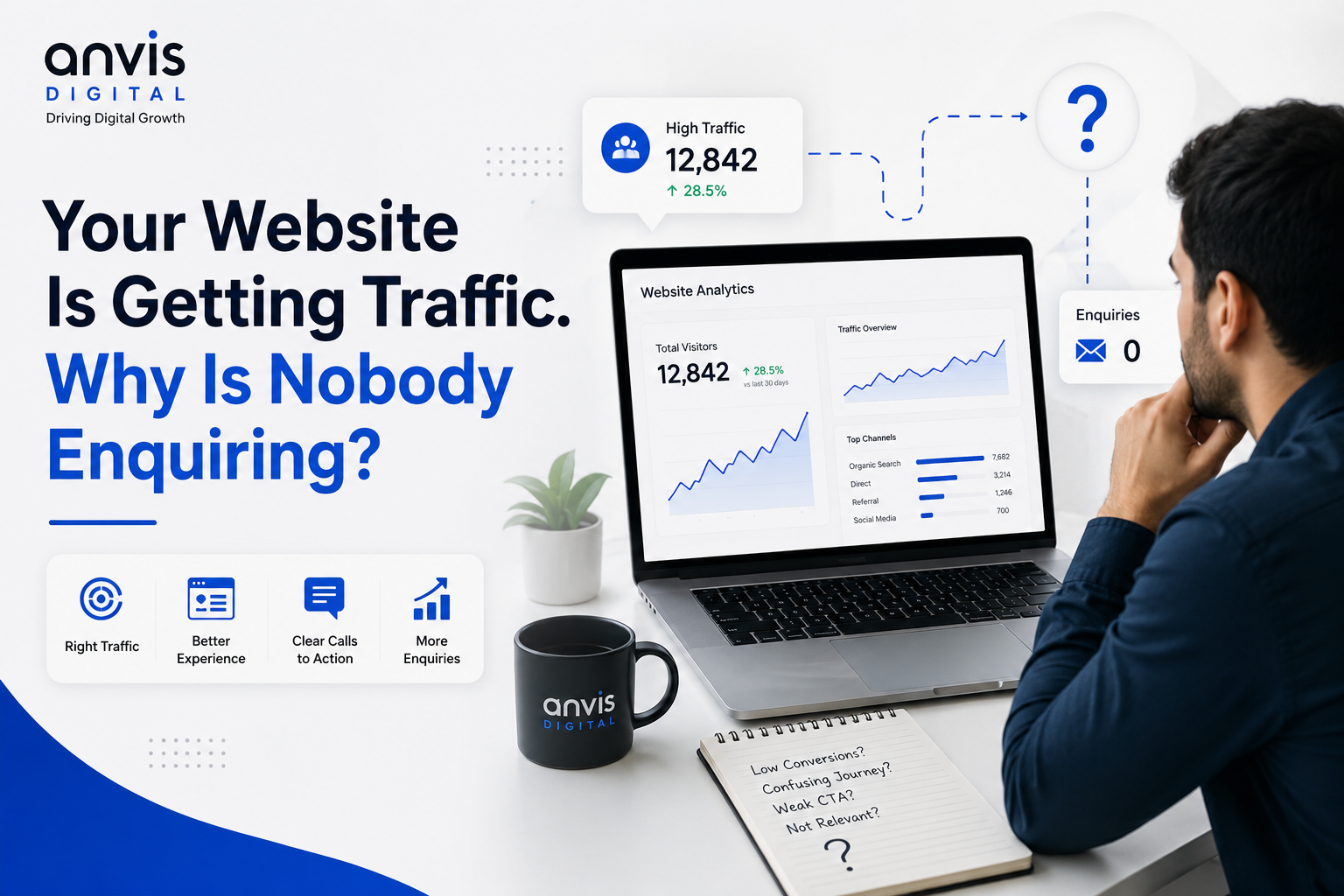
The website traffic looks healthy.
People are arriving through Google, paid campaigns, social media, referrals, and content. The reports show growing sessions, clicks, impressions and page views.
But the enquiry inbox remains painfully quiet.
This is where brands often make the wrong diagnosis. They assume they need more traffic and increase their SEO or advertising investment. But sending more visitors to a website that is not converting only sends more people into the same broken experience.
Traffic proves that people found you. It does not prove that they understood you, trusted you or knew what to do next.
That is why website conversion optimization matters. The real question is not only how many people reached your website. It is what happened after they arrived.
People are arriving through Google, paid campaigns, social media, referrals, and content. The reports show growing sessions, clicks, impressions and page views.
But the enquiry inbox remains painfully quiet.
This is where brands often make the wrong diagnosis. They assume they need more traffic and increase their SEO or advertising investment. But sending more visitors to a website that is not converting only sends more people into the same broken experience.
Traffic proves that people found you. It does not prove that they understood you, trusted you or knew what to do next.
That is why website conversion optimization matters. The real question is not only how many people reached your website. It is what happened after they arrived.
The Traffic Was Never Right for the Business
Not all traffic carries the same value.
A visitor researching a broad topic behaves differently from someone comparing service providers. One wants information. The other may be close to making an enquiry.
Brands often celebrate traffic growth without examining the intention behind it. A blog may attract thousands of readers, while a service page attracts fewer visitors with much stronger commercial intent.
This is where search intent optimization becomes essential. Content, keywords, ads, and landing pages must attract people whose needs match what the business actually provides.
Traffic without intent creates impressive dashboards, not business opportunities.
A visitor researching a broad topic behaves differently from someone comparing service providers. One wants information. The other may be close to making an enquiry.
Brands often celebrate traffic growth without examining the intention behind it. A blog may attract thousands of readers, while a service page attracts fewer visitors with much stronger commercial intent.
This is where search intent optimization becomes essential. Content, keywords, ads, and landing pages must attract people whose needs match what the business actually provides.
Traffic without intent creates impressive dashboards, not business opportunities.
Visitors Cannot Understand the Offer Quickly
A website may look modern and still make users work too hard.
Visitors arrive and encounter headlines such as “Transforming Possibilities,” “Solutions for Tomorrow” or “Excellence Delivered.” The language sounds polished, but it does not explain what the company offers, who it serves or why it matters.
Within moments, the website should answer four questions:
What do you offer?
Who is it for?
Why should people trust you?
What should they do next?
Good conversion-focused web design is not only about visual appeal. It creates a clear hierarchy that guides attention from the customer’s problem to the brand’s solution, proof, and next step.
A beautiful website that creates confusion is simply well-designed friction.
Visitors arrive and encounter headlines such as “Transforming Possibilities,” “Solutions for Tomorrow” or “Excellence Delivered.” The language sounds polished, but it does not explain what the company offers, who it serves or why it matters.
Within moments, the website should answer four questions:
What do you offer?
Who is it for?
Why should people trust you?
What should they do next?
Good conversion-focused web design is not only about visual appeal. It creates a clear hierarchy that guides attention from the customer’s problem to the brand’s solution, proof, and next step.
A beautiful website that creates confusion is simply well-designed friction.
The Website Creates Hesitation
Most businesses describe themselves as experienced, reliable, innovative or customer focused.
The problem is that every competitor says the same thing.
Visitors need proof. They look for case studies, client names, specific outcomes, testimonials, credentials and project examples.
Trust must also remain consistent across the journey. If an advertisement feels premium but the website appears outdated, confidence drops. If a service page promises expertise but provides little detail, confidence drops.
Sometimes the visitor is ready to act, but the website adds resistance. The contact button is hidden. The form is too long. The call to action is vague.
Conversion often disappears through small moments of uncertainty.
The website should not merely invite action. It should make that action feel safe, relevant and easy.
The problem is that every competitor says the same thing.
Visitors need proof. They look for case studies, client names, specific outcomes, testimonials, credentials and project examples.
Trust must also remain consistent across the journey. If an advertisement feels premium but the website appears outdated, confidence drops. If a service page promises expertise but provides little detail, confidence drops.
Sometimes the visitor is ready to act, but the website adds resistance. The contact button is hidden. The form is too long. The call to action is vague.
Conversion often disappears through small moments of uncertainty.
The website should not merely invite action. It should make that action feel safe, relevant and easy.
Your Landing Page Is Trying to Do Everything
Some landing pages attempt to serve every audience, explain every service, display every achievement and promote several actions at once.
The result is choice without direction.
Effective high-converting landing pages are built around one audience, one central need and one primary action. Their purpose is to help the right visitor confidently take the next step.
The message must also match the source of the traffic. Someone clicking an advertisement about a specific service should not arrive on a generic homepage and begin searching again.
The promise made before the click must continue after it.
When ads, search intent, landing-page copy and calls to action are disconnected, traffic arrives with momentum and immediately loses it.
The result is choice without direction.
Effective high-converting landing pages are built around one audience, one central need and one primary action. Their purpose is to help the right visitor confidently take the next step.
The message must also match the source of the traffic. Someone clicking an advertisement about a specific service should not arrive on a generic homepage and begin searching again.
The promise made before the click must continue after it.
When ads, search intent, landing-page copy and calls to action are disconnected, traffic arrives with momentum and immediately loses it.
Conclusion
If your website is attracting traffic but generating few enquiries, acquiring more visitors may not be the answer.
Examine the intent behind the traffic. Clarify the offer. Strengthen the proof. Simplify the journey. Align landing pages with campaigns. Remove friction from the enquiry process.
Traffic is only the arrival.
Growth begins when the website gives people enough clarity and confidence to take the next step.
Examine the intent behind the traffic. Clarify the offer. Strengthen the proof. Simplify the journey. Align landing pages with campaigns. Remove friction from the enquiry process.
Traffic is only the arrival.
Growth begins when the website gives people enough clarity and confidence to take the next step.