

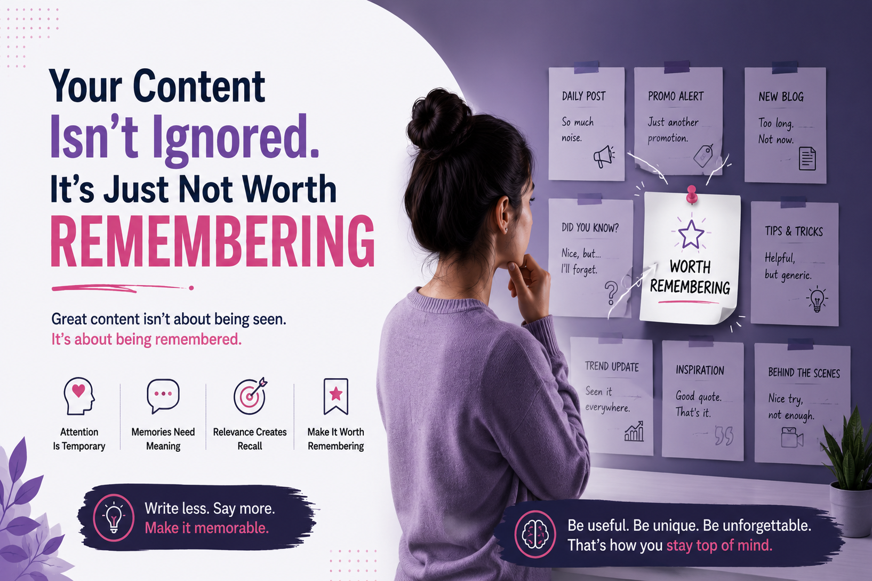
Most brands think their content is being ignored. The reality is sharper: people are seeing it, processing it for a second and forgetting it almost immediately.
That is not only an algorithm problem. It is not always a reach problem. It is usually a recall problem.
In a crowded digital ecosystem, audiences see posts, reels, ads, emails, banners, search results, influencer content and brand messages every day. The brands that win are not simply those that publish more. They are the ones that become easier to remember.
That is where a strong content marketing strategy matters. Content should not exist to fill a calendar. It should build recognition, trust, recall and action over time.
That is not only an algorithm problem. It is not always a reach problem. It is usually a recall problem.
In a crowded digital ecosystem, audiences see posts, reels, ads, emails, banners, search results, influencer content and brand messages every day. The brands that win are not simply those that publish more. They are the ones that become easier to remember.
That is where a strong content marketing strategy matters. Content should not exist to fill a calendar. It should build recognition, trust, recall and action over time.
Content is Not a Posting Exercise
Many brands confuse activity with communication.
They post regularly, run campaigns, make reels. They write blogs. They boost festive creatives.
They maintain a presence across platforms. But the audience still cannot answer one simple
question:
“What does this brand stand for?”
That is the real issue.
Content that is visually polished but strategically empty may get attention for a moment, but it
does not create memory. The design may look good, the caption may be neat, and the format
may be trending, but if the idea is not distinct, the audience moves on.
A sharp content marketing agency should not only ask what to post this week. It should ask
what the audience should remember about the brand after seeing ten pieces of content.
That question changes content from a production task into a brand-building system.
They post regularly, run campaigns, make reels. They write blogs. They boost festive creatives.
They maintain a presence across platforms. But the audience still cannot answer one simple
question:
“What does this brand stand for?”
That is the real issue.
Content that is visually polished but strategically empty may get attention for a moment, but it
does not create memory. The design may look good, the caption may be neat, and the format
may be trending, but if the idea is not distinct, the audience moves on.
A sharp content marketing agency should not only ask what to post this week. It should ask
what the audience should remember about the brand after seeing ten pieces of content.
That question changes content from a production task into a brand-building system.
Why Most Content Disappears?
Content usually becomes forgettable for three reasons.
First, the content sounds like every other brand. “Quality you can trust,” “solutions for your needs,” “innovation that matters” and “your growth partner” are not memorable messages. They are wallpaper.
Second, the brand changes direction too often. One week it sounds premium. Next week it sounds funny. Then educational. Then sales heavy.
Variation is useful, but inconsistency is expensive.
Third, the content is disconnected from the rest of the marketing ecosystem. Social media says one thing. Ads say another. The landing page says something else. Sales teams use a different pitch. The brand becomes visible but not memorable.
This is why content needs strategy before volume.
First, the content sounds like every other brand. “Quality you can trust,” “solutions for your needs,” “innovation that matters” and “your growth partner” are not memorable messages. They are wallpaper.
Second, the brand changes direction too often. One week it sounds premium. Next week it sounds funny. Then educational. Then sales heavy.
Variation is useful, but inconsistency is expensive.
Third, the content is disconnected from the rest of the marketing ecosystem. Social media says one thing. Ads say another. The landing page says something else. Sales teams use a different pitch. The brand becomes visible but not memorable.
This is why content needs strategy before volume.
Memory is Built Through Repetition with Variation
Being memorable does not mean repeating the same post again. That becomes boring.
Memory is built when a brand repeats the same strategic idea through different creative expressions.
A healthcare brand may consistently build its messaging around “expert care made human.”
A real estate brand may own “premium living without everyday compromise.”
A fitness brand may own “discipline that fits real life.”
A digital agency may own “connected growth, not scattered marketing.”
Each post can look different. Each channel can behave differently. Each campaign can have its own creative layer. But the larger brand idea must remain consistent.
This is where multi-channel advertising becomes powerful. A customer may first discover the brand through a reel, then see a performance ad, visit the website, read a blog, notice a display ad, receive an email and finally convert.
If every touchpoint strengthens the same memory, the brand becomes sharper. If every touchpoint introduces a new message, the brand resets itself every time.
That reset is where money quietly disappears.
Memory is built when a brand repeats the same strategic idea through different creative expressions.
A healthcare brand may consistently build its messaging around “expert care made human.”
A real estate brand may own “premium living without everyday compromise.”
A fitness brand may own “discipline that fits real life.”
A digital agency may own “connected growth, not scattered marketing.”
Each post can look different. Each channel can behave differently. Each campaign can have its own creative layer. But the larger brand idea must remain consistent.
This is where multi-channel advertising becomes powerful. A customer may first discover the brand through a reel, then see a performance ad, visit the website, read a blog, notice a display ad, receive an email and finally convert.
If every touchpoint strengthens the same memory, the brand becomes sharper. If every touchpoint introduces a new message, the brand resets itself every time.
That reset is where money quietly disappears.
Media Cannot Save Forgettable Content
Many brands try to solve weak content with more distribution.
They increase budgets. They boost more posts. They test more audiences. They hire a media buying agency to improve reach and efficiency.
Media buying matters. It can place the brand in front of the right audience at the right time. It can reduce wastage and scale performance. But media cannot make a forgettable idea memorable by force.
Paid media amplifies the strength of the message. It does not replace it.
If the content is clear, distinct and connected to the customer’s real need, media gives it momentum. If the content is generic, media simply pays for more people to forget it faster.
This is why the strongest effective advertising campaigns are not built by separating creative, content and media. They are built when all three work together from the beginning.
The idea determines what should be remembered.
The content gives that idea shape.
The media gives it movement.
The website converts the interest.
The data shows what is working.
That is connected growth.
They increase budgets. They boost more posts. They test more audiences. They hire a media buying agency to improve reach and efficiency.
Media buying matters. It can place the brand in front of the right audience at the right time. It can reduce wastage and scale performance. But media cannot make a forgettable idea memorable by force.
Paid media amplifies the strength of the message. It does not replace it.
If the content is clear, distinct and connected to the customer’s real need, media gives it momentum. If the content is generic, media simply pays for more people to forget it faster.
This is why the strongest effective advertising campaigns are not built by separating creative, content and media. They are built when all three work together from the beginning.
The idea determines what should be remembered.
The content gives that idea shape.
The media gives it movement.
The website converts the interest.
The data shows what is working.
That is connected growth.
Conclusion
Your content is not ignored because people hate content. People remember stories, ideas, opinions, visuals, emotions and brands that make sense quickly.
But they forget content that feels generic, inconsistent or disconnected.
The solution is not to shout louder. It is to become clearer. Build a content marketing strategy that gives your brand a memorable point of view. Create content that reinforces that point of view across platforms. Connect it with media, campaigns, website journeys and business goals.
Because the most valuable content is not the content people simply see.
It is the content they remember when they are ready to act.
But they forget content that feels generic, inconsistent or disconnected.
The solution is not to shout louder. It is to become clearer. Build a content marketing strategy that gives your brand a memorable point of view. Create content that reinforces that point of view across platforms. Connect it with media, campaigns, website journeys and business goals.
Because the most valuable content is not the content people simply see.
It is the content they remember when they are ready to act.